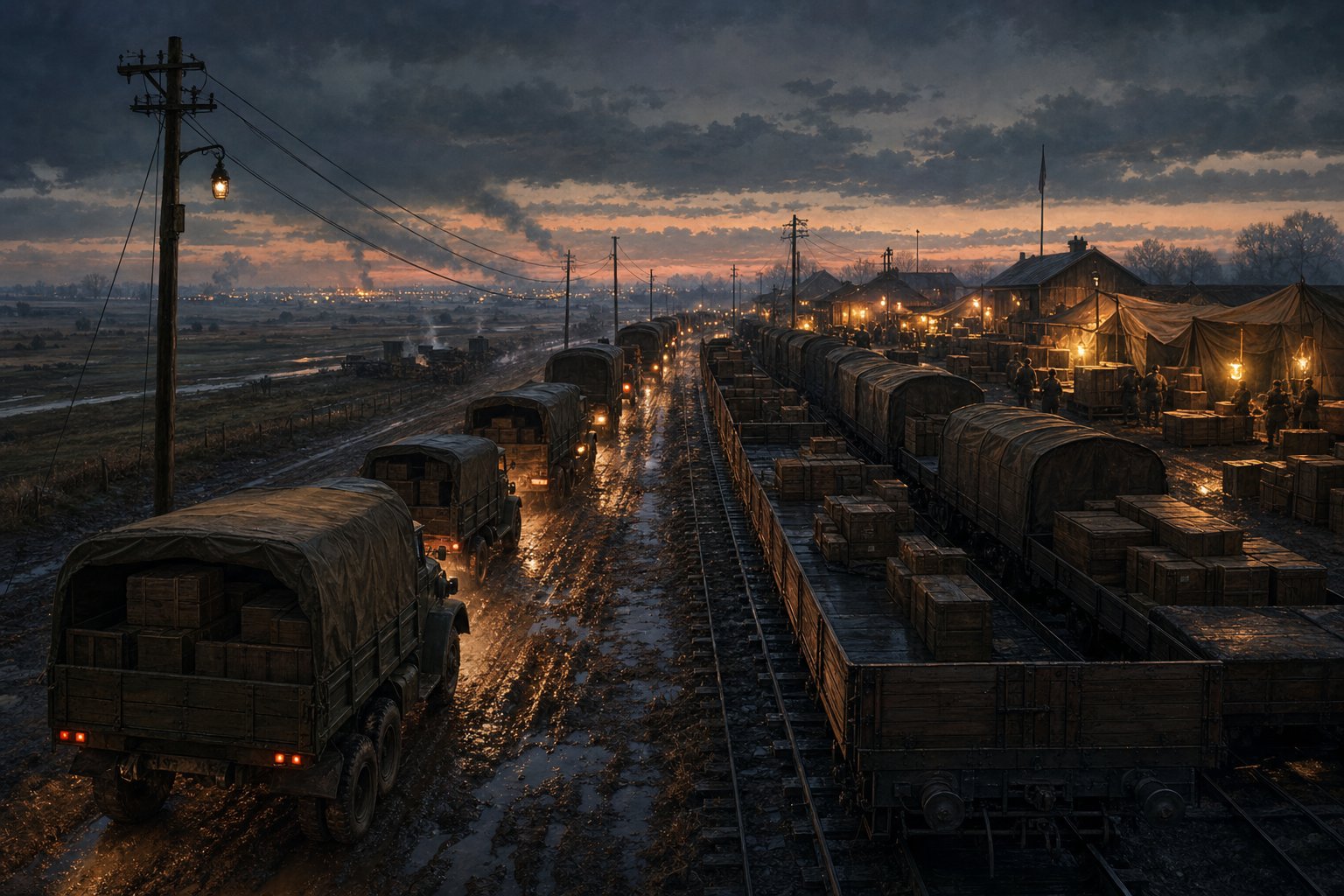
Supply is the reason a strong army can still lose. A division with good stats fights badly when it cannot recover organization, replace equipment, or receive fuel. Once you understand the route supply takes, most stalled offensives stop looking random: the army outran its hubs, one weak rail segment strangled the front, convoys were being sunk, or the template demanded more than the province could support.
The Supply Mental Model
Think in systems, not icons. Your capital is the source. Railways and ports are the routes. Supply hubs are the local distributors. Divisions, air wings, and ships are the consumers.
- The capital creates the main pool. A bigger economy supports more supply, but the supply still needs a valid route outward.
- Railways move supply. They do not feed troops standing next to them unless a hub or port distributes that supply locally.
- Supply hubs feed provinces around them. Range and effectiveness depend on distance, terrain, infrastructure, and motorization.
- Ports are sea-facing hubs. They use convoys instead of trains, so sea control becomes part of supply.
- State supply is local support. Population, victory points, and infrastructure can help a state feed units, but empty states cannot replace a real network.
The practical conclusion is simple: every front is a logistics corridor. If you push along hubs, rails, and ports, your units keep their stats. If you push away from them, even elite divisions start fighting like damaged infantry. This is why supply is not just a repair task after the line turns red. It is part of the attack plan.
Read the Supply Map
Use the supply map before you attack, not only after the army is starving. The colors give a quick warning, but the tooltip is the real answer. Hover the province and nearby hub to see what the area receives, what your units consume, and which route element is limiting flow.
Diagnose in this order:
- Province first. If only one tile is red, you probably stacked too many divisions, tanks, planes, or ships there.
- Nearest hub or port. Hover it and follow the highlighted route back toward your capital.
- Bottleneck. If the game marks a weak or damaged rail segment, repair or upgrade that segment first.
- Equipment. Missing trains, trucks, or convoys make good infrastructure behave badly.
- Motorization. A hub on horses has short reach. Trucks extend the range if you can afford them.
Pause while doing this. Supply problems are easy when you read them like a chain. They become expensive when you click construction randomly and keep attacking while the chain is broken.
Hubs, Railways, and Bottlenecks
A supply hub needs a route back to the capital. A railway needs a hub or port to distribute supply at the far end. Treat those as separate jobs: railways carry, hubs hand out.
The most important railway rule is the bottleneck rule. The weakest rail segment on the route controls how much supply reaches the hub. A long level-3 route with one weak segment behaves like the weak segment. That is why the hub tooltip matters: it shows the route you should fix instead of making you guess.
Use the hub's bottleneck upgrade button when the highlighted route is the problem. It queues the limiting rail upgrades for that hub; if several levels are needed, click again after the next bottleneck appears. Manual rail upgrades still work, but the button prevents wasted construction on irrelevant rail lines.
Do not make new hubs your first fix. They are expensive, slow, and useless until connected. Build one only when no existing hub or port can cover the area, the front will matter for a long time, and you can connect the hub before the army depends on it. Prepared Soviet defensive lines, deep China routes, and low-network African corridors are real cases. A two-week emergency push is usually not.
| Network part | What it does | Common mistake | Better fix |
|---|---|---|---|
| Capital | Provides the main national supply source. | Assuming it feeds disconnected fronts. | Keep routes outward repaired and connected. |
| Railway | Moves supply to hubs. | Building rails to front tiles with no hub. | Upgrade the bottleneck route into a hub. |
| Supply hub | Distributes supply to nearby provinces. | Building one without a rail connection. | Connect, repair, and motorize active hubs. |
| Infrastructure | Adds local state supply and improves movement conditions. | Treating it as a hub replacement. | Improve important corridors and defensive areas. |
| Port | Acts as a hub for sea supply. | Ignoring convoys and sea control. | Upgrade the port and protect the route. |
Motorization, Trucks, and Attrition
Motorization is the fastest way to make an existing hub reach farther. Hubs use horse delivery by default. Raising motorization spends trucks from your stockpile and extends the local radius. The normal levels are horse, trucks, and more trucks; in-game tooltips show the current truck demand, commonly 0, 40, and 80 trucks per hub.
Motorize where range is the limiting factor and troops are actually drawing supply. A quiet interior hub on trucks wastes equipment. A front-line hub on horses can starve an army that would be fine with truck delivery.
You can set motorization per hub for static fronts, or per army and army group for moving fronts. Army motorization is cleaner during offensives because the relevant hubs change as divisions advance. Check logistics fulfillment after raising it. If the bar goes red, you ordered more truck supply than your stockpile can support.
Trucks are consumed by supply distribution, motorized units, and support companies. They also suffer attrition and can be hit by logistics strikes. Produce them early, keep the line running, and avoid maxing every hub just because the button exists. Trains deserve the same quiet attention: most countries do not need a huge train industry, but running out of trains can break an otherwise good rail network.
Ports, Convoys, and Overseas Supply
Ports are supply hubs for fronts that cannot be reached by land. They use convoys instead of trains, so an overseas army depends on three things at once: a working port, enough convoys, and a sea route the enemy cannot freely raid.
This is why naval invasions should take a port immediately. Divisions carry a small supply buffer, so landing next to a port can work for a short fight, but the landing force must capture and repair a port before that buffer runs out. After that, expand from port to hub, not from random beach to random inland tile.
Ports can be cheaper than inland hubs when you control the sea. Upgrading a naval base or taking a better port can support a whole theater. But convoys are vulnerable to submarines, surface raiders, and naval bombers, so convoy escort and air cover are part of the supply plan. Also check fleets sitting in port: ships consume supply too, and a large navy can strain the same area your invasion army needs.
Division Demand and Terrain
Supply has two sides: capacity and demand. You can fix the route perfectly and still overload a province by parking too much army in one place.
Division demand comes from battalions, support companies, equipment type, doctrine, commander traits, and national modifiers. Tanks, motorized, mechanized, artillery-heavy units, and large templates demand more than plain infantry. Logistics companies reduce that demand and are especially valuable on tanks, special forces, and any unit expected to fight far from dense rail networks. For the template side, use the HoI4 division templates guide.
The local part matters. One province can be red while nearby provinces are fine. If every tank is stacked on one tile, the problem may be the stack, not the hub. Spread divisions, attack from multiple directions, or move idle infantry away from the spearhead.
Terrain and weather raise the price of bad planning. Desert, jungle, mountains, marsh, mud, snow, heat, and storms can reduce effective supply, slow movement, and burn trucks through attrition. Fight there with fewer units, lighter templates, logistics companies, and planned pauses for repair. Do not send the same stack into central Africa that worked in northern France.
| Demand source | Why it strains supply | Cleaner answer |
|---|---|---|
| Stacked infantry | Many divisions draw from one province. | Thin the line and keep reserves behind it. |
| Tanks | High supply and fuel needs punish weak hubs. | Attack from supplied tiles and add logistics companies. |
| Motorized armies | They need trucks in templates and hubs. | Produce trucks early and motorize only active routes. |
| Full air bases | Air wings consume local supply. | Use better-connected bases and avoid overfilling weak regions. |
| Fleets in port | Ships can compete with land forces. | Move fleets to stronger ports when armies are starving. |
| Bad terrain | Movement, attrition, and truck losses worsen. | Use fewer units, lighter templates, and repair pauses. |
Offensives, Captured Hubs, and Air Supply
Good offensives follow supply lines. Great offensives break the enemy's supply while protecting their own.
Before attacking, open the supply map and mark the enemy hubs, ports, and rail junctions. These are often better objectives than nearby victory points. Capturing a hub can weaken several enemy provinces at once. Cutting a rail line can make the hub behind it useless. Taking the port in an overseas theater can starve the whole army.
Captured hubs and railways are not instant. They need time to convert, repair, and reconnect to your capital. Fast tank pushes often win the first battle and then stall because the network is still behind them. Pause on captured hubs, repair the route, let infantry catch up, then push again.
- Start supplied. Tanks attacking from red provinces waste their breakthrough.
- Push toward a logistics objective. Hubs, ports, and rail junctions matter more than pretty arrows.
- Protect the route behind the spearhead. Losing one rail tile can stop the whole push.
- Pause after capture. Conversion and repair are part of the offensive cycle.
- Use air supply as a bridge. Transport planes can save a landing or deep push, but they are not a permanent network.
Logistics strikes apply the same principle to the enemy. Bombing trains, rails, and hubs makes defenders weaker before combat starts. It works best when paired with ground objectives: bomb the route, capture the hub, and exploit before repairs catch up. For the air side, read the HoI4 air superiority and CAS guide.
Fixing Low Supply
When a front turns red, use a checklist. The goal is to identify which leg failed before spending months on construction.
| Symptom | Likely cause | Fast fix | Long fix |
|---|---|---|---|
| Whole front near one hub is red. | Rail bottleneck, damage, or short hub range. | Hover hub, repair rails, click bottleneck upgrade, motorize if trucks exist. | Upgrade the route corridor and improve key infrastructure. |
| Only one province is red. | Too many units in one tile. | Move divisions to nearby provinces. | Stop battle plans from piling reserves into the same tile. |
| Hub looks good but supply collapses. | Missing trains or trucks. | Check logistics fulfillment and lower unused motorization. | Keep train and truck production running before war. |
| Overseas army starves. | No port, weak port, missing convoys, or unsafe sea route. | Take or repair a port and escort convoys. | Upgrade naval bases and secure the sea lane. |
| Tanks win then stop. | The spearhead outran supply and fuel. | Pause on a hub and move excess infantry away. | Plan attacks from hub to hub and use logistics companies. |
| Trucks vanish. | Attrition, weather, terrain, or logistics strikes. | Lower unnecessary motorization. | Add air cover, more trucks, and better timing. |
Prevent most supply crises with a few habits: build trains and trucks early, keep convoys in production for naval countries, avoid overfilling low-supply fronts, use the allied-supply toggle when friendly AI floods a critical hub, and make supply part of template design. A division that only works in perfect supply is not a campaign division.
Battle plans can make supply worse by shuffling too many units into the same weak area. Use plans for planning bonus and broad pressure, but control spearheads manually and watch the supply overlay as the line moves. The HoI4 battle plans guide covers that control problem in more detail.
The fastest fix is often removing demand. Pull divisions away, spread tanks out, stop the attack, and then repair the route. Building a new hub is the expensive answer after the cheap answers fail.
FAQ
Why are my HoI4 divisions out of supply?
Your divisions are consuming more supply than the local province receives. Common causes are disconnected hubs, rail bottlenecks, damaged routes, missing trains or trucks, weak ports, missing convoys, or too many divisions in one tile.
Do railways give supply to nearby units?
No. Railways move supply to hubs and ports. Hubs and ports distribute it locally. A railway to the front helps only if it connects a distributor.
Should I build supply hubs everywhere?
No. New hubs are expensive and slow. First repair rails, upgrade bottlenecks, motorize active hubs, use ports, improve key infrastructure, or reduce local troop demand. Build a hub when no existing distributor can cover an important long-term front.
How many trucks do I need for supply?
Enough to cover the hubs and armies you motorize while still supporting truck-using templates and support companies. Check the logistics fulfillment bar and hub tooltip. If raising motorization turns fulfillment red, the order is too expensive right now.
Why does a captured supply hub not work?
It needs time to convert, repair, and connect back to your capital. Pause around captured hubs before expecting them to feed the next push.
Are transport planes worth using for supply?
Yes, as a temporary bridge for naval landings, rough terrain, or deep pushes. They are not a replacement for hubs, ports, railways, and convoys.
How do I hurt enemy supply?
Capture hubs, ports, and rail junctions; cut rail lines; bomb logistics when you have air power; and encircle divisions until their stored supply runs out.
Next Reads
- HoI4 Division Templates 2026 Guide - build divisions your supply network can support.
- HoI4 Air Superiority and CAS Guide - use fighters, CAS, and logistics strikes without starving air bases.
- HoI4 Battle Plans Guide - stop front lines from shuffling too many divisions into bad supply.
- HoI4 Beginner Guide 2026 - connect supply to research, production, and your first war plan.
- HoI4 Germany Guide 2026 - practice hub-to-hub offensives in a structured campaign route.
- HoI4 Console Commands and Cheats List - test supply situations quickly in a sandbox save.