
Europa Universalis V has a much deeper economy than older EU-style “income minus expenses” systems. Your treasury is only the visible result of a larger machine: population, estate taxes, control, food, buildings, production methods, goods, markets, and trade all push your income up or down.
If your country is losing money in EU5, the answer is usually not just “raise taxes.” A province can look rich on paper and still send very little income to your treasury if control is low. A building can exist but produce poorly if it lacks workers or input goods. A market can look active but fail to supply the resources your army, cities, or industries actually need.
This guide explains the practical economy loop: how to stop losing money, how to improve your tax base, how to use markets and trade, and how to avoid the bankruptcy spiral.
Editorial note: EU5 mechanics can change after patches. This guide is based on current Paradox Wiki information and official EU5 economy/trade descriptions. Recheck numbers after major updates.
Quick Answer: How to Fix Your Economy in EU5
If you are losing money, start with these steps:
- Cut nonessential army, navy, and fort maintenance only if you are safe from war.
- Improve control in your richest provinces first.
- Keep estates satisfied enough that you can tax them without triggering instability.
- Make sure your population has food and basic goods.
- Stop building structures that cannot get workers or input goods.
- Use trade to cover missing market goods, not just to chase abstract profit.
- Use minting and loans carefully; they solve short-term problems but can create inflation or bankruptcy risk.
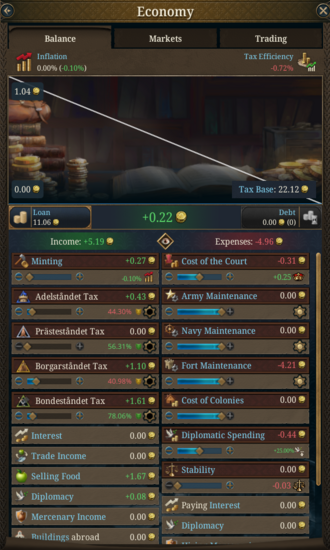
How EU5’s Economy Works
EU5’s economy is built around goods and people. Locations produce raw goods, buildings transform or use goods, pops work in those buildings, markets set prices through supply and demand, and estates receive shares of local wealth before taxes reach your state.
That means money problems usually come from one of four places:
- You are spending too much.
- You are not collecting enough of your potential tax base.
- Your production chain is blocked by workers, goods, or prices.
- Your market cannot supply what your country needs.
The best way to grow is to fix the bottleneck, not to spam buildings blindly.
Emergency Fixes When You Are Losing Money
When your balance turns negative, go to the budget first. Maintenance sliders are the fastest tool, but they are not free money. Lower army maintenance can leave you unprepared for war. Lower navy maintenance can hurt exploration or naval readiness. Lower fort maintenance weakens your defensive posture.
Use cuts as breathing room, not as your whole strategy.
| Problem | Likely Cause | Fast Fix | Long-Term Fix |
|---|---|---|---|
| Negative monthly balance | High maintenance or overbuilding | Lower safe maintenance sliders | Grow tax base and trade income |
| Rich province gives little money | Low control | Use control actions in rich areas | Build roads/ports and integrate territory |
| Construction pauses | Missing goods in market | Import needed materials | Build local supply chain |
| Building output is low | Missing input goods or workers | Subsidize or switch priorities | Build around available goods and pops |
| Food shortage | Demand exceeds local/provincial/market food | Import food or reduce pressure | Invest in food production and storage |
| Inflation rising | Too much minting or precious metal pressure | Reduce minting | Unlock inflation tools and diversify economy |
| Loan spiral | Expenses exceed real income | Cut nonessential spending | Fix control, taxes, production, and trade |
Control: Your Hidden Income Multiplier
Control is one of the most important economy mechanics in EU5. A location’s potential tax base is not automatically collected at full value. Control determines how much of that value actually becomes usable.
If a location has strong production but low control, you are leaving money on the table. This is especially common in distant, newly conquered, poorly connected, or low-integration areas.
Improve control through:
- roads and better connections to the capital;
- ports and coastal networks;
- cabinet actions where available;
- integration and core status;
- useful administrative or religious buildings;
- focusing first on wealthy provinces, not poor borderlands.
Beginner rule: improve control where the tax base is already high. A small control increase in a rich province is usually worth more than perfecting a poor one.
Estates, Taxes, and Satisfaction
Your state does not simply collect money from an empty map. Local tax base is distributed through estates based on the population and power structure of each location. Then your tax settings determine how much reaches the treasury.
This creates a balancing act:
- Higher taxes bring more money now.
- Angry estates can create instability later.
- Happy estates can tolerate more taxation.
- Some governments, laws, or privileges may limit who can be taxed.
For beginners, automated estate taxation is often safer while learning the system. Once you understand your country, manual estate taxation becomes a way to squeeze more income from powerful groups without breaking stability.
Food and Population Needs
Food is not just flavor in EU5. Population, armies, and markets all interact with food supply. Shortages can harm population growth, migration, supply limit, and long-term economic strength.
Think of food in three layers:
- local food, produced and consumed in a location;
- provincial food, stored and used within a province;
- market food, bought and sold at the market level.
If your population is starving, your economy will not grow cleanly. A profitable economy needs workers, and workers need enough food and basic goods to remain productive.
Buildings and Production Methods
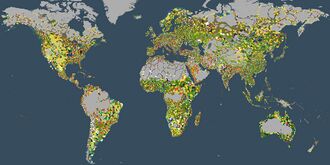
Buildings are not simple flat bonuses. Many buildings need input goods, employed pops, and a market that can actually supply what they consume. If a building lacks its required goods, its output can fall. If there are no workers, it cannot perform at full capacity.
Before building, ask:
- Does this location or market have the input goods?
- Are there enough workers?
- Is there demand for the output?
- Will the building improve an existing bottleneck?
- Am I creating a supply chain or just adding upkeep?
Good early investments usually support basic production, food, control, or market access. Bad investments are expensive buildings that cannot get inputs or workers.
Markets, Trade Capacity, and Trade Advantage
Markets are where goods are bought and sold. A location belongs to a market, and prices change based on supply and demand. If your market lacks lumber, stone, food, metalworks, or naval supplies, your construction, production, or military plans may stall.
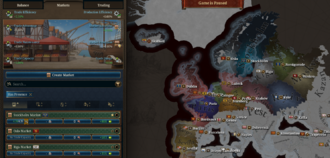
Trade is useful because no country starts with everything it needs. Importing can cover missing inputs. Exporting can turn surplus goods into profit. But trade is limited by trade capacity, distance, maintenance, and market access.
Beginner trade priorities:
- Import goods that unblock construction or key buildings.
- Secure food and basic needs before luxury optimization.
- Expand trade capacity in important markets.
- Export real surplus goods, not goods your own economy needs.
- Watch whether a route is profitable after maintenance.
Minting, Loans, and Bankruptcy
Minting gives you more money quickly, but pushing it too far can increase inflation. Loans can save you during a crisis, but they are dangerous if they only pay for a broken budget. Bankruptcy can clear debt, but it also brings harsh penalties and can cripple your country for years.
Use minting and loans to bridge a fix, not to avoid making one.
Safe uses:
- funding a short war you can win;
- finishing infrastructure that will improve income;
- surviving a temporary shock;
- buying time while control or trade improvements take effect.
Dangerous uses:
- paying permanent over-maintenance;
- funding buildings that cannot produce;
- ignoring estate unrest;
- covering food shortages without fixing supply.
Beginner Economy Checklist
- Is my monthly balance positive during peace?
- Are rich provinces suffering from low control?
- Are estates satisfied enough to tax safely?
- Is food supply stable?
- Are important buildings fully staffed?
- Are production methods missing input goods?
- Is my market short on construction or military goods?
- Do I have enough trade capacity?
- Are loans funding growth or only delaying bankruptcy?
- Is minting creating inflation faster than I can handle?
Common Mistakes
The biggest beginner mistake is treating money as isolated from the rest of the country. In EU5, money follows the health of the whole system.
Do not:
- build everywhere without checking goods and workers;
- ignore control in distant provinces;
- overtax angry estates;
- cut military maintenance right before a war;
- rely on minting as a permanent income source;
- export goods your own production chain needs;
- ignore food shortages because the treasury still looks fine.
FAQ
Why am I losing money in EU5?
Usually because maintenance is too high, control is too low, estates are not being taxed efficiently, buildings are unprofitable, or your market cannot supply needed goods.
Why does a rich province give me almost no income?
Low control can reduce the amount of local tax base you actually collect. Improve control in rich areas before investing heavily in poor ones.
Should I automate estate taxation?
For beginners, yes. Automation is useful while learning the economy. Later, manual taxation can be stronger if you understand estate satisfaction and privileges.
Is minting bad?
Minting is not automatically bad, but excessive minting can increase inflation. Use it as a short-term tool, not a permanent replacement for a working economy.
Why did my building stop working?
It may lack input goods, workers, or profitable conditions. Check the market supply, employment, and production method requirements.
How do I make trade useful?
Use trade to solve bottlenecks first. Import goods you need for construction, food, buildings, or military supply. Export only real surplus goods.
How do I avoid bankruptcy?
Cut temporary expenses, improve control in rich provinces, keep estate taxation stable, stop unprofitable construction, avoid excessive minting, and use loans only to support fixes that will actually improve income.
Related Guides
Sources
- Europa Universalis 5 Wiki: Economy
- Europa Universalis 5 Wiki: Market
- Europa Universalis 5 Wiki: Buildings
- Europa Universalis 5 Wiki: Goods
- Official Europa Universalis V page
EU5 Trade and Markets Deep Dive
If your biggest problem is trade routes, market access, imports, exports, or trade capacity, use the focused EU5 Trade and Markets Guide as the next step after this economy overview.
EU5 Control Deep Dive
If rich provinces, mines, or conquered locations look valuable but barely move your treasury, read the EU5 Control Guide next. It explains how proximity, integration, and local control convert potential wealth into taxable value.
EU5 Buildings and Production Deep Dive
When your economy has stable control and market access, the next question is what to build and where. The EU5 Buildings Guide explains RGOs, production methods, input shortages, workers, and why profitable-looking buildings can still disappoint.
EU5 Bankruptcy, Loans, and Minting Deep Dive
If a campaign is already sliding into automatic loans, inflation, or a debt spiral, use the EU5 Bankruptcy Guide for emergency triage before taking more loans or declaring bankruptcy.
EU5 Estates and Crown Power Deep Dive
When income, authority, privileges, or tax rates are the bottleneck, use the EU5 Estates and Crown Power Guide to separate control, estate share, estate tax, satisfaction, and crown power.