
An EU4 veteran's reflex is to treat estates as flavor: accept the starting privileges, ignore the panels, and play the map. Europa Universalis 5 punishes that reflex hard. Estates sit directly between your economy and your state. They take their share of everything your land produces, they decide how much of that share you can tax back, they staff your cabinet and command your armies, and when they are unhappy they lower your control, stall your growth, and put armies in the field against you. Crown power is the other side of the same ledger — the share of national authority your dynasty actually holds. A rich country with weak crown power plays poor, and a modest country with strong crown power plays far above its weight.
Two mental models carry the entire system. The first is the pool: crown and estates divide one fixed pie of power, so nothing you do destroys influence — it only moves it. The second is the triangle: taxes, satisfaction, and authority pull against each other, and you never max all three at once. Every privilege, every tax slider, and every rebellion in the game is a consequence of those two shapes. Understand them and you will never need a memorized build order again, because you will be able to read any country's estate screen — on any patch — and know exactly what to touch.
One Pool of Power
Most countries start with five estates: the crown (your dynasty and the state itself), the nobility, the clergy, the burghers who work the urban buildings, and the commoners — everyone else, which in practice means most of your population. Muslim realms add the dhimmi estate for people of other Abrahamic faiths, and a tribes estate appears wherever tribesmen pops live, which can happen to European nations too. Each estate's power grows from its population, its privileges, and a long list of modifiers — and all of it adds up inside one shared pool with the crown.
This is the single most important fact in the system: estate power is zero-sum. You cannot add power to the world or remove it; you can only redistribute the slices. Shrinking the nobility does not make the country freer — it makes the clergy, the burghers, and the commoners proportionally stronger. "Destroy the nobles" is therefore not a strategy, it is a redistribution with your name on the wrong side of it. Containing one estate while ignoring the others simply moves your problem. The skill is managing the whole equilibrium: deciding which estate should be strong (usually the burghers, late game) and holding every other slice in check.
Crown power is your slice of that pie, and it converts into state capacity at several places at once. It sets the share of trade profit that actually reaches your treasury — hold a fifth of the pool and you keep a fifth of every hundred ducats of trade. It scales cabinet efficiency, the cost of changing policies, and the cost of revoking privileges. And it feeds your base support in parliament, which means crown power even decides how easily you can pass the laws that raise crown power further. Weak crown power is not one penalty; it is a tax on every action the state takes.
There is a threshold you should know by feel. Let crown power fall below roughly a quarter of the pool and a stack of debuffs engages — cabinet efficiency, tax efficiency, policy costs, diplomatic reputation, and upkeep all get worse. Push past it and those same modifiers flip into buffs. The exact list and the exact numbers live in the government panel, and they have moved between patches, so read the panel once at the start of a campaign rather than trusting any fixed figure — but the first strategic milestone of nearly every game is the same: get the crown past the threshold as fast as you can, and never let it slip back below.
The estates have a mirror-image threshold of their own. An estate holding more than its share of power accepts very little taxation; push it below that line and the tax slider finally opens up. This is why the early-game nobility — often sitting on over half the pool from stacked starting privileges — pays almost nothing, while the weak burghers and commoners can be taxed hard from day one. Your tax problem is almost never the tax slider. It is the power distribution underneath it.
One consequence ties the whole section together: every privilege you grant dilutes the crown. Six casual grants across four estates are six permanent modifiers fighting your crown buffs until the day you pay stability to revoke them. Granting is cheap — it costs a small amount of legitimacy — while revoking costs stability scaled by how powerful the estate has become. The asymmetry is the point: you cannot experiment with privileges. You slot them deliberately, knowing the price of taking them back.
The Satisfaction Triangle
If the pool explains who holds power, the triangle explains what it costs to use it. Three goals pull against each other: extracting taxes, keeping estates content, and concentrating authority in the crown. Pressing an estate — taxing it harder, revoking its privileges — buys authority and revenue, but spends satisfaction. You cannot max all three corners at once. Good estate play is choosing where on the triangle you want to stand at each phase of the campaign, and moving deliberately instead of drifting.
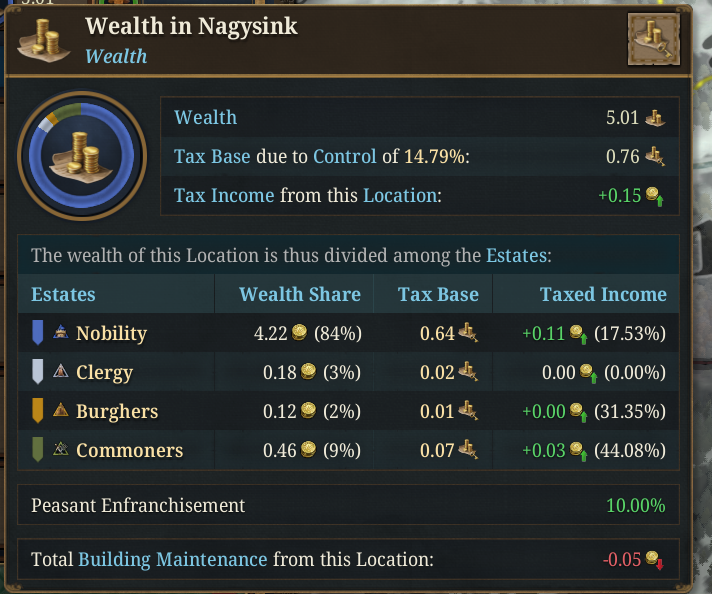
Location value passes through control, then splits among the estates by power, and only then becomes taxable. The estate layer is where most "rich country, poor treasury" mysteries die.
The mechanic everyone misreads is that satisfaction is not a number you set — it is a number that drifts toward an equilibrium cap. Grant a privilege and satisfaction spikes instantly, then decays month by month down to its cap. Revoke one and satisfaction crashes, then slowly climbs back up to the cap. The durable levers are the things that move the cap itself: the estate's privileges, your societal values, country stability, and your ruler's diplomatic skill. One-time buttons are just that — one-time. Plan around the equilibrium, not the spike.
Taxation trades against that equilibrium at close to one-for-one: each point of tax rate costs roughly a point of satisfaction. Let satisfaction slide below about half and the estate stops being cooperative — it pays less, contributes less to control, and eventually raises rebels. The nobility is the hardest to keep content and the most dangerous when it finally revolts; a mass commoner revolt, meanwhile, can bury you in sheer numbers if you let satisfaction collapse across the board. Read each estate's projected equilibrium in its panel before you raise a tax slider, not after the revolt fires.
Satisfaction is worth more than the tax gate, though. High satisfaction adds control to the estate's locations. Low satisfaction subtracts control and prosperity — and prosperity is what drives population growth and development growth. An unhappy estate does not just pay less this month; it makes its provinces grow slower for years, and the penalty compounds. This is why satisfaction is the stat veterans protect first and spend last.
Two facts decide whose satisfaction matters most. Location satisfaction is the simple average of every pop in the location, and commoners are by far the most numerous pop — so commoner satisfaction quietly drives the satisfaction of your entire map. Meanwhile, noble satisfaction is the hardest to push high, and it gates the tax rate on the estate that holds the most wealth early. The practical hierarchy: pay up for noble and peasant satisfaction, treat clergy satisfaction as medium priority, and be picky with burghers, whose satisfaction is so easy to obtain that it routinely runs past full. When a burgher privilege offers satisfaction at a steep price in power, you are allowed to say no. When a noble privilege does it, you usually cannot.
Finally, the reason you should never squeeze an estate to death: estate money is circular. The share an estate keeps does not vanish. It is re-spent on market goods — nobles spend the most per head on luxuries like fur, amber, and weaponry — and that spending is the demand that makes your own buildings profitable. Estates also lend money, and in EU5 most loans only exist because estates have savings to lend. Bankrupt your estates and you can go bankrupt beside them, in a country that looks rich on every map mode. A prosperous burgher estate is not a leak in your budget; it is your best customer and your bank.
Where Crown Power Comes From
Now the levers. The principle first: crown power comes from controlled population, concentrated in cities, and above all in your capital — not from the amount of land you have painted. A huge realm of low-control provinces is a realm whose crown power is being confiscated at the local level and reassigned to the estates before it ever reaches your national pool. Fix control before you stack anything else, or you are pouring water into a leaking bucket. The control guide covers proximity in full; everything below assumes you are at least reasonably in command of your own territory.
| Lever | What it gives | The catch |
|---|---|---|
| Cabinet composition | A crown-estate minister adds roughly 12.5% crown power per seat; making one head of cabinet adds another 25%. Two crown ministers plus the chair can approach a 50% bonus from seats alone | A dynasty child with weak stats may still beat a brilliant commoner for the office — and never give the problem estate a seat, let alone the chair |
| Ruler in command | Your ruler commanding the entire army or fleet adds about 25% crown power; an heir or a partial command gives less, scaling with the share of units commanded | Commanders die. Deploy the ruler deliberately, not habitually |
| Centralization | A societal value that scales into a huge flat crown-power bonus at 100 — up to +50% nationwide. Fed by holding parliament in your capital, high average development, high control, and centralizing laws | Values move slowly and one trend at a time; this is a decade-scale investment |
| Capital buildings | The serjeantry (monarchies) adds roughly 25% local crown power plus manpower; the royal court adds about 10% nationwide plus cabinet efficiency | The royal court is hungry for luxury goods — its bonus scales with operating capacity, so an unfunded court pays a fraction of its headline value |
| Laws and reforms | Setting the distribution-of-power law to favor the ruler instead of the traditional setup flips a penalty into a roughly +20% bonus plus extra maximum tax. Autocracy-style reforms and the early statecraft and sovereignty advances each add smaller stacks | Change laws through parliament for a share of support rather than paying raw stability — and parliamentary support itself scales off crown power |
| Legitimacy | Scales crown power directly, up to about +10% at the top | Legitimacy decay is silent crown-power decay; keep it pinned |
| Placetum regime (Christian realms) | A large flat crown-power bonus — on the order of +20% — for pulling the realm away from the church's authority | Heavy estate-satisfaction and religious-influence debuffs; usually wrong for Pope-aligned powers, often right for realms headed toward heresy anyway |
| What silently drains it | Low-control provinces hand their crown share to the estates; overextending diplomatic capacity applies a "too many relations" penalty that grows the further over the cap you go | Trim relations back under the cap and fix control before chasing any bonus above |
Two of those levers deserve emphasis because beginners systematically undervalue them. The cabinet is the biggest hidden multiplier in the game. Seats are worth a fixed slice of power for whichever estate holds them — so a crown-estate child in the cabinet is worth +12.5% crown power even if his stats are mediocre, and appointing him head of cabinet roughly triples that. The appointment costs legitimacy and gold, so invest it in a young character who will serve forty years, not a seventy-year-old genius. The mirror warning matters just as much: cabinet power is bidirectional. If the nobility is your problem, hiring nobles into your government feeds the exact estate you are trying to starve. Do not hire the arsonist as your fire chief.
The second is the parliament loop. Your base support in parliament is a fraction of your crown power — read the chamber panel for the current ratio — which means crown power makes parliament easier, and parliament passes the centralizing laws and crown-supporting issues that raise crown power. The loop either compounds for you or against you. "Parliament never supports anything" is almost never a parliament problem; it is a crown power problem wearing a legislative costume. Once the crown is strong, use parliament to change laws — it costs a share of support rather than a triple-digit stability bill — and watch for the recurring issues that grant temporary surges of crown power or cut revoke costs. Those temporary buffs are renewable, and timing your big moves to coincide with them is the difference between an affordable cleanup and an impossible one.
What a Privilege Actually Costs
Every privilege card shows you a list of modifiers and tempts you to read it like a shopping list. That is the wrong lens. The real price of a privilege is not on the card at all — it is the estate power you hand over, which stays on the board diluting your crown and capping your taxes until you pay stability to revoke it. Evaluate every privilege on three axes: the modifiers themselves, the societal trend the privilege pushes, and the ratio of satisfaction bought per point of power spent. The ratio is the one most players never compute, and it is the one that decides whether a grant is a bargain or a loan shark.
A useful par: five percent satisfaction for fifty percent estate power — a 1:10 ratio. Anything above that line is a fair deal; anything below it is suspect. But the value of satisfaction is not equal across estates, and this is where the judgment lives. Noble and peasant satisfaction are the hardest to obtain and the most consequential — nobles hold the early wealth, and peasants dominate the location-satisfaction average — so you pay up for them. Clergy sit in the middle. Burgher satisfaction is so easy that you should treat every burgher power-grant with suspicion: if the estate is already content, you are buying nothing with the satisfaction and paying full price in power. For commoners the ratio stops mattering entirely, because commoners almost never become powerful; there you simply buy absolute satisfaction and demographic value and ignore the rate.
Two hard rules override all of this, and they are not negotiable on any patch:
- Any privilege that lowers your maximum control is an automatic reject. Control is the master stat of the entire game — it multiplies your tax base, your crown power, and your growth. A card that trades it away is bad no matter what else it offers, and you can ignore the rest of the tooltip. The classic offender is the feudal-lordship style privilege that hands the nobility enormous power, lowers max control, and makes pops more likely to join rebellions — the single worst card in the game. If you start with one, planning its revoke is part of your opening.
- Never trade away maximum tax on the burghers. Burghers are your main tax base in almost every campaign. Privileges that cap or cut burgher taxation — toll exemptions, monetary-policy rights — quietly cost more than they return unless you specifically run a gold- and silver-minting empire. Do the math on your own minting income versus the lost tax before you slot one; most of the time the answer is no.
Beyond the hard rules, learn to see through dead modifiers so they stop impressing you. Cultural defense is worthless because you are the one attacking. Flat bonuses that do not scale — the equivalent of one building, a small artist salary, a monthly chance of art — fall behind percentage modifiers within decades. Wild game output modifies a good whose value is food, and food does not scale with output bonuses. Noble literacy moves almost nothing because nobles are a tiny share of population. A card stacked with these is usually a power grab dressed as a gift.
One modifier category is worth more than its numbers suggest: anything that grants development. In EU5, demand — the thing that makes your economy grow — comes from development, not from raw economic growth, which is why every country eventually hits artificial demand walls. Development is the scarcest strategic resource in the game, and privileges that drip-feed it compound into hundreds of development over a full campaign. This is why the burgher development-grant privilege is close to a universal first slot, a point we will come back to.
Finally, the trend dimension. Every privilege pushes a societal value, and values are the slow currents that decide what your country can do in fifty years. The winning pattern is concentration, not sprinkling: push one value to 100 first, then slot the privileges that run against it, because by then the trend is locked and the counter-push is free. Early game, the value to max is almost always communalism — at 100 it halves the cost of every privilege revoke in the game, which is the enabler for the entire cleanup phase covered below. Slot your communalism-pushing privileges first, strip them later, and only then start spending the individualism and other counter-trend cards that looked dangerous in 1337.
Privileges by Estate: Slot and Strip
With the pricing model in hand, the per-estate picture falls into place quickly. The table below is the working board; the paragraphs after it cover the traps, because the traps are where campaigns actually die.
| Estate | Slot without thinking | Strip or never take | The one-line why |
|---|---|---|---|
| Nobility | Levy and combat-efficiency privileges while your army still runs on levies; land rights early for the automatic RGO expansion; elaborate court life once communalism is maxed | Primacy of the nobility in the early game; 50%-power cards whose benefits you will not actually use; anything that lowers max control | Noble satisfaction is the hardest to buy and gates your richest early tax base — pay for it in power, but only for satisfaction or real military value |
| Clergy | Faith-strengthening and advisory-council privileges (cheap power, good trends); clerics-in-cities privileges, which are a hidden bonus; cultural-unity privileges when you must assimilate neighbors | Tax exemption for the clergy; any corruption privilege; anything that blocks university construction past the first age | Clergy satisfaction scales research and conversion, and their power is a reasonable price — but you do want to be able to tax them, eventually |
| Burghers | Urban development grants on day one of every nation; the road-building privilege; commercial advisory council; building rights; land of commerce | Guild investments (a trap: bad rate, temporary value, and burghers grow too strong to revoke from); trade monopolies; formal guilds; any max-tax penalty | Burgher satisfaction is easy, so you are allowed to be picky — buy development and trade capacity, and almost nothing else |
| Commoners | Common militias; free mobility so pops migrate toward useful locations; communal lands if you are committed to serfdom, since it pushes no free-subjects trend | Means of production, whose production-efficiency loss hits building income — your largest late-game income; anything pushing you off your chosen peasant trend | Commoners never become powerful, so ignore the ratio and buy raw satisfaction and demographic value |
| Tribesmen | Anything with satisfaction and no downside; levy privileges while you still hold many tribesmen | Everything with a downside — especially any privilege that blocks assimilation | Tribesmen emit negative proximity and hold back your map; the plan is always to promote and assimilate them out (Cossacks are the classic exception) |
| Dhimmi (Muslim realms) | Dhimmi levy size; humanist and cultural-capacity privileges when expanding across faith lines | Legal autonomy, maximum-tax penalties, and most of the rest | A tolerance estate: pay for assimilation speed and capacity, not for permanent separation |
The primacy-of-the-nobility trap. This is the classic noob snare, and it is worth naming directly because the card looks magnificent on a first playthrough: a flat discipline bonus plus a doubling of noble power. Early, when your army is almost entirely levies, the discipline does close to nothing — while doubled noble power wrecks your taxes, your crown power, and your next decade of revokes. Late, with a professional army that actually benefits from discipline, the same card becomes reasonable. The card did not change; your army did. Most early-game privilege regret traces back to this exact shape: a modifier you cannot yet use, bought with power you will spend years removing.
The 50-percent-for-nothing family. A whole cluster of noble privileges — royal marriage rights and its cousins — offers around fifty percent estate power in exchange for cabinet crumbs or minor efficiency. Noble power is the most expensive resource in the early game, and in patches where aristocracy trends matter it only gets pricier. Do not spend it for pennies: if a privilege pays no satisfaction and its modifiers could be called "nice," the answer is no. The one exception worth naming is the agenda-impact card — a privilege whose real product is pushing your parliament over the passage threshold. It pays no satisfaction either, but early, when chambers are close fights, that push is worth real power. It falls off once your parliament is established, so treat it as a phase tool you may later strip, not a permanent grant.
The two universal slots. If you take nothing else from this section, take these. The burgher urban development grants privilege costs a modest amount of power and drips development — the scarcest resource in the game — from day one to the end of the campaign; skipping it can cost you hundreds of development by the late game, and there is essentially no nation where that trade is correct. The burgher road-building privilege is its peer: roads raise control, replace infrastructure investments you would have made yourself, and carry effectively no downside. Every nation, every game, both slots.
Pick a peasant direction and stop hedging. The entire commoner tier shifts depending on whether you commit to serfdom or to free subjects. Serfdom likely makes more money and upgrades food-consumption privileges into genuine population-growth engines; free subjects makes reaching near-perfect satisfaction — and therefore escaping all control and prosperity maluses — far easier. Both are defensible. Hedging between them is what makes peasant privileges look random, because half the tier quietly pushes one trend and half the other. Decide from your country's shape, commit, and evaluate every commoner card against the commitment.
Revoking Done Right
Every campaign eventually reaches the cleanup phase: the starting privileges are choking you, the estates are fat on power, and it is time to buy the country back. This is where most players bounce off, because they attempt it in the wrong order and conclude the mechanic is broken. It is not broken. It is priced to teach you sequencing.
The math, as a principle: the stability cost of a revoke starts from a large base number and is multiplied by the target estate's share of the power pool — then multiplied down by your discounts, chiefly communalism (up to a halving at 100), your crown power, and the late-game era values that arrive with absolutism. The revoke tooltip shows your exact current cost, and reading that number is the skill: it is telling you, to the point, whether you are ready. An estate holding well over half the pool makes every revoke against it cost a kingdom's worth of stability. The same privilege, revoked after the estate has been diluted to a tenth of the pool with communalism maxed and crown power stacked, costs single digits. Early in a campaign, revoking is meant to be near-impossible; by the late game it is meant to be near-free. That arc is the design, not a bug.
The sequence that respects the math:
- Diagnose. Check which estate actually holds the pool. For many nations it is the nobility, but plenty of starts are strangled by the clergy, the burghers, or even over-privileged commoners. The estate panel ranks them for you; act on the data, not the stereotype.
- Dilute. Because the pool is fixed, granting privileges to the estates that are not the problem mechanically shrinks the problem estate's share — their gain is its loss, and every point of dilution lowers the revoke cost you are about to pay. Build pop-demand buildings that pull population out of the problem estate's strata (more on this below). Do this before any revoke, not after.
- Stack. Assemble every crown-power lever from the previous section — cabinet, command, laws, buildings, legitimacy — and layer the temporary buffs on top: the parliament issues that back the crown, event buffs, anything renewable. Time the revoke turn to land while the stack is at its peak.
- Revoke the biggest power first. Stripping the highest-power privileges first resets the equilibrium fastest and makes every subsequent revoke cheaper. Alternatively, lead with the privileges doing the most economic damage — max-control losses first, always.
- Repeat on a cycle. Parliamentary buffs renew, communalism keeps paying, and estate power keeps falling. Plan two or three revoke turns spread across decades rather than one heroic afternoon.
Watch for windows. The Black Death situation hands you extra communalism trend through several of its options — isolating or expelling the sick is grim roleplay and a genuine discount on the cleanup, which is why veterans treat the plague as an opportunity rather than a disaster. Country-specific arcs do the same at a larger scale: Brandenburg's Robber Barons disaster, handled patiently, ends with a burst of centralization and a decade-long window of cheaper revokes. The entire crown-power meta is built around banking stability during the hard years and spending it inside one of these windows.
And budget for the rebellion, because revoking noble privileges triggers one — on purpose. A noble revolt is not a failure state; it is part of the transaction. When the rebellion fires it resets that estate's satisfaction to roughly half, which is a controlled way to recover satisfaction you would otherwise grind for years. Rebels cannot rise in vassal provinces, so if you have vassals or strong allies, let them do the fighting while you take minimal penalties. In extreme cases, rebel occupation of your capital can wipe out the local noble, cleric, and burgher populations entirely — a brutal, rare window in which the offending estate's power collapses and its remaining privileges become almost free to strip. You do not engineer this casually. But when it happens, recognize it for what it is.
The Long Game: Pops, Money, and the Full Strip
The deepest lever in the system is the one that operates on a generational timescale: demographics is politics. Estate power grows from population, and every pop counts toward its estate's share. Promotion between strata is demand-capped — pops only rise when buildings exist that need them — which means you can engineer the political map through your build menu. In a Catholic realm, monasteries, scriptoriums, and cathedrals create demand for clerics, pulling peasants up out of the commoner pool. Market villages and their burgher-employing kin pull peasants into the cities instead. Every promotion out of the estate you are trying to shrink is a permanent transfer of power that no revoke can match for durability. Monasteries and market villages do not just build your economy; they build your political balance. This is the answer to "how do I contain the nobility without revoking anything yet" — you outgrow them.
The mirror of this is estate-funded construction, a mechanic many players never notice. Estates spend their own money on their own buildings, and those buildings raise that estate's power. Some of it helps you; some of it does not, and late game estates can build genuinely harmful structures — pirate havens being the poster child — with no benefit to the state. Demolishing an estate building lowers that estate's power, which makes it a quietly powerful cleanup tool, but the demolition costs estate satisfaction, so it is a trade to make deliberately, not a free action to automate. Watch what your estates build the way you watch your own build queue.
Which brings us to the extreme version, because you will be tempted: the full strip. Revoke every estate privilege, concentrate the entire pool in the crown, and ride the loop — more crown power makes the next revoke cheaper, which concentrates more power, which makes the next one cheaper still. At its peak this build reaches crown-power levels that feel like cheating, with revokes costing almost nothing and the state apparatus running at full efficiency. It is real, and it works. It is also honest to name the bill, because the bill is real. With no estates holding privileges, parliament support for anything but crown issues collapses — road debates fail, centralization debates fail, and even casus belli generation starves. Satisfaction stays permanently low; your people will simply hate you, forever, and that is the price of the ticket. And certain costs refuse to move no matter how much crown power you accumulate — some trends, like entrenched aristocracy, barely budge even under maximum pressure. The full strip is a legitimate build with a legitimate downside: you are trading consent for authority. Decide which game you want to play before you start stripping, because the build is far easier to enter than to reverse.
One last callback ties the whole guide together. For all the talk of curbing estates, the end state of a great campaign is not a crushed estate class — it is a redirected one. The burghers you fed all game become the demand engine that makes your late economy run, the creditors who float your wars, and the tax base that finally dwarfs the nobles'. The nobles you spent two centuries dismantling stop being a political problem and become what they should have been in 1337: one estate among five, paying their share. The early game is about taming the nobility; the late game is about feeding the burghers; and crown power is the dial that decides how much of either you get away with. Learn the pool, respect the triangle, and the rest is just sequencing.
FAQ
What is crown power in EU5?
It is your dynasty's share of one fixed pool of national power that you divide with your estates. It converts into state capacity at several points at once: your share of trade profit, cabinet efficiency, policy-change costs, the cost of revoking privileges, and your base support in parliament. Below roughly a quarter of the pool you eat a stack of debuffs; above it, those flip into buffs. Read the government panel for the exact current values.
How do I raise crown power fast?
The fastest single move is putting your ruler in command of the entire army or fleet, which shifts crown power within weeks — mind his survival. Then fix the structural levers: a crown-estate head of cabinet, the distribution-of-power law set to favor the ruler (changed through parliament, not raw stability), legitimacy near the top, and the capital buildings. Everything compounds once the parliament loop starts turning.
Should I revoke privileges early?
Almost never. Revoke cost scales with the estate's share of the pool, and early estates hold enormous shares — a basic noble privilege can cost more stability than you will earn in a decade. Change the conditions first: dilute the estate by granting to others, push communalism toward 100, stack crown power, and wait for a discount window like the Black Death. The mechanic is priced to be impossible early and near-free late.
Why can't I raise taxes on my strongest estate?
The tax slider is capped by the estate's power and by its satisfaction. An estate holding more than its share of power accepts very little tax, and tax itself trades against satisfaction at close to one-for-one. The fix is never the slider — it is raising satisfaction to the equilibrium cap and pushing the estate's power below its threshold, in that order.
What is the best first privilege to grant?
Urban development grants for the burghers, on virtually every nation. Development is the scarcest resource in the game — it is what creates demand — and this privilege drips it from day one for a modest amount of power. The burgher road-building privilege is the other universal slot. Both compound for the entire campaign.
Why does my parliament never pass anything?
Base parliamentary support is drawn from your crown power, so a weak crown produces a hostile chamber by construction. Raise crown power, hold parliament in your capital to feed centralization, and early game consider the privileges that add agenda impact — they push you over the passage threshold frequently until your parliaments are established.
Is the full-strip crown-power meta actually good?
It is strong and it is honest: you concentrate the whole pool in the crown, revokes become nearly free, and the state runs at full capacity. The cost is permanent — estate satisfaction never recovers, parliament dies for everything but crown issues, casus belli generation starves, and some entrenched values refuse to move regardless. Treat it as a deliberate build with a real downside, not as the default way to play.
Next Reads
- EU5 Economy Guide — the full wealth chain from location to treasury, of which estates are one link.
- EU5 Control Guide — control and proximity, the master stat that crown power is built on.
- EU5 Buildings and Production Methods Guide — which demand buildings pull pops where you want them.
- EU5 Bankruptcy, Loans, and Minting Guide — estate savings are your lenders; this is what happens when the circle breaks.
- EU5 Trade and Markets Guide — how crown power's share of trade profit actually reaches you.
- EU5 Beginner Guide: First 50 Years — the opening checklist that sequences estates, economy, and war.
- EU5 Best Starter Nations — which countries teach estate management gently and which throw you to the nobles.
- EU5 Warfare Guide — levies, professionals, and mercenaries: what your estates are actually paying for.
- EU5 Diplomacy Guide — vassals and allies, the people who fight your estate rebellions for you.
- Castile First 50 Years and Hungary First 50 Years — two estate arcs played out in full, step by step.