
Estates in EU5 are not just a roleplay layer. They sit directly between your economy and your government. They can pay taxes, build things, demand privileges, shape satisfaction, affect authority, and limit how much of your country's wealth becomes usable state power.
Crown power is the other side of that bargain. High crown power means a stronger state. Weak crown power means more power in estate hands and weaker central authority.
If your economy looks rich but your treasury is weak, the problem may not be production. It may be that control, estate shares, estate tax, and crown power are filtering the value before you see it.
For the broad money guide, start with the live EU5 Economy Guide. If the problem is state reach, use the EU5 Control Guide. If estates are weak because the economy is underbuilt or debt-ridden, use the EU5 Buildings Guide and EU5 Bankruptcy Guide. This page focuses on estates, privileges, taxes, and crown power.
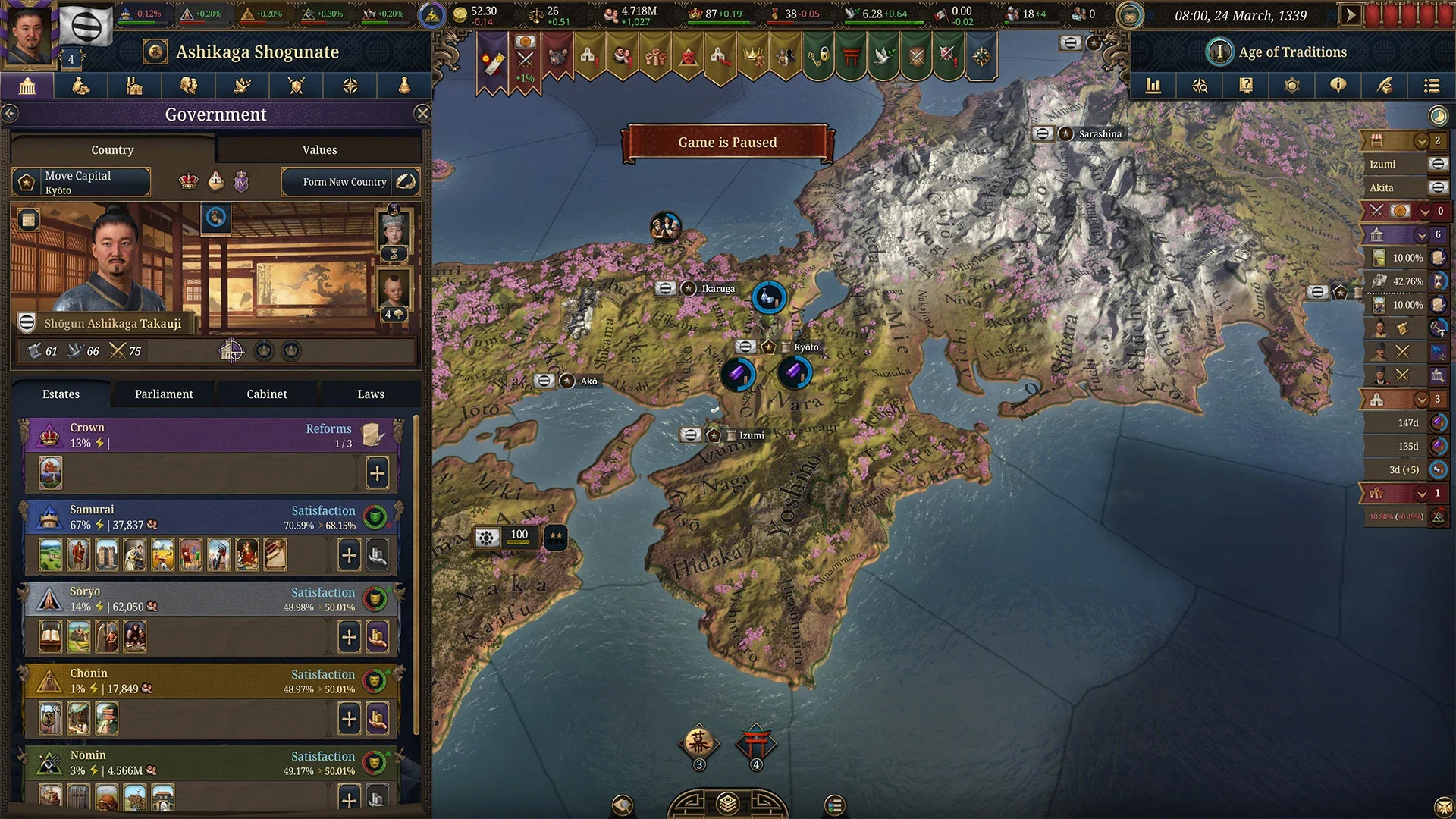
_Estate power, satisfaction, and crown authority are economy controls, not just flavor. Official Paradox screenshot._
Quick Answer: What Estates and Crown Power Do
Estates represent powerful social groups inside your country. They receive shares of economic value, can be taxed, have satisfaction levels, gain or lose power, and can receive privileges.
Crown power represents the authority of the state compared with those estates. The Crown Estate is special because it does not represent a normal population estate in the same way. It represents government power that other estates do not hold.
In practice:
- estates can help fund the state through taxes;
- unhappy estates can become a stability and rebellion problem;
- privileges can solve short-term problems but increase estate power;
- crown power supports government efficiency and long-term centralization;
- estate/crown balance changes how much economic growth becomes state power.
The Four Layers of EU5 Income
When a location creates value, it does not all jump directly into your treasury.
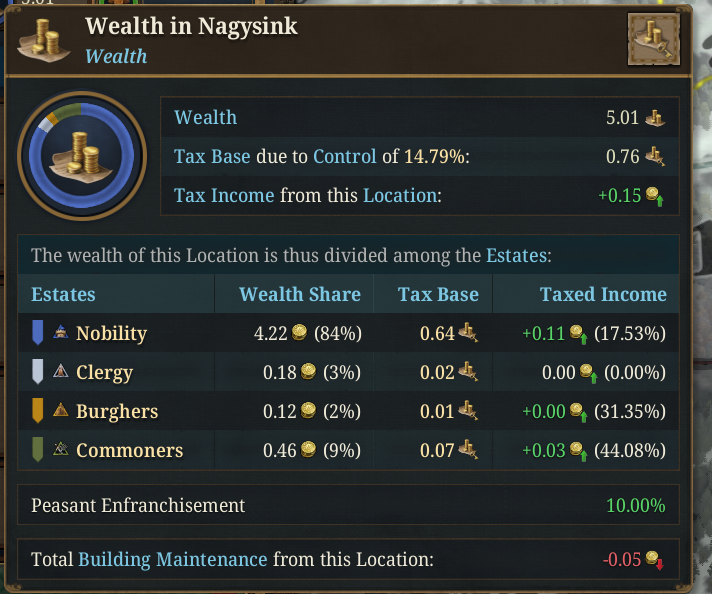
_Location value passes through control and estate layers before it becomes usable state income. Official Paradox Tinto screenshot._
| Layer | Question |
|---|---|
| Potential value | What can the location produce through RGOs, buildings, and activity? |
| Control | How much of that value becomes effective tax base? |
| Estate share | Which estates receive that tax base? |
| Estate tax | How much do those estates pay to the country? |
Crown power and government authority then affect broader state efficiency, including areas like cabinet performance, privilege costs, and economic capture depending on current patch mechanics.
This is why one slider rarely fixes the whole economy. A country can have strong production but low control. Or good control but weak estate taxation. Or high estate taxes but collapsing satisfaction.
Estate Power Explained
Estate power is the influence an estate has in your country. The wiki explains that power is calculated from population, local and national modifiers, privileges, reforms, and other factors.
Power matters because estates are not passive. A powerful estate can be useful if it is satisfied and aligned with your plan, but dangerous if it blocks reforms, demands privileges, or withholds too much value from the state.
The key is not "all estates bad." The key is balance.
Crown Power Explained
Crown power is the state's share of authority. As checked against the Paradox Wiki on May 5, 2026, low Crown Estate power can penalize cabinet efficiency, court cost, change policy cost, tax efficiency, and estate-building destruction satisfaction impact. High Crown Estate power can improve cabinet efficiency, court cost, change policy cost, power projection, revoke privilege cost, and estate satisfaction equilibrium. Exact values remain patch-sensitive, especially because player discussions show confusion around taxes, trade income, and tax efficiency.
As a practical guide:
- below key thresholds, weak crown power can hurt state efficiency;
- higher crown power makes central government stronger;
- privileges and reforms can shift power between estates and crown;
- bankruptcy and some crisis states can damage crown power severely.
Do not chase crown power blindly. A stronger crown that triggers estate anger or ruins a useful privilege setup can still create instability. But do not ignore it either. Low crown power often explains why a state feels weaker than its map size suggests.
Estate Satisfaction and Tax Rates
Estate taxes are a major economy lever. Raising estate taxes can improve short-term income, but it can also reduce satisfaction if pushed too hard.
Use estate taxes with three questions:
- Can the estate afford the tax?
- Will satisfaction remain stable?
- Does the extra income solve a real problem?
Automation can be useful for avoiding constant micro, but it is not a replacement for understanding the system. If your economy is in crisis, inspect estate taxes manually and see whether the estates are the bottleneck.
Privileges: When to Grant and When to Revoke
Privileges are tradeoffs. The wiki explains that estate privileges can provide bonuses and increase satisfaction, but also increase estate power. Granting and revoking privileges costs resources and affects satisfaction.
Grant privileges when:
- the bonus directly solves an immediate problem;
- the satisfaction gain prevents instability;
- the estate power increase is acceptable;
- the privilege supports your long-term country plan.
Delay privileges when:
- you only want a minor bonus;
- the estate is already too powerful;
- revoking later would be expensive;
- the privilege makes crown power problems worse.
Revoke privileges when:
- you can absorb the stability/satisfaction cost;
- the privilege no longer supports the economy;
- it blocks centralization or reform;
- the estate has become too dominant.
Avoid the two extremes: privilege spam and immediate universal revocation. Both can work in specific campaigns, but neither is a safe beginner rule.
Estate Buildings and Local Power
Estates can build. That is not automatically bad. An estate-built food or input building can support the whole market. But estate buildings can also reinforce local estate power, clutter a location plan, or produce goods you do not need.
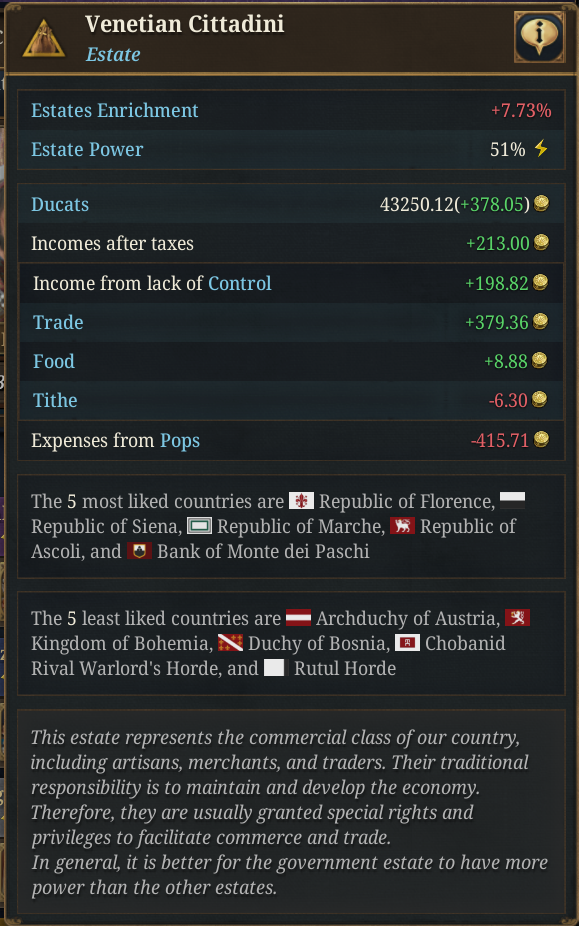
_Estate income can include control, trade, food, taxes, expenses, enrichment, and estate power. Official Paradox Tinto screenshot._
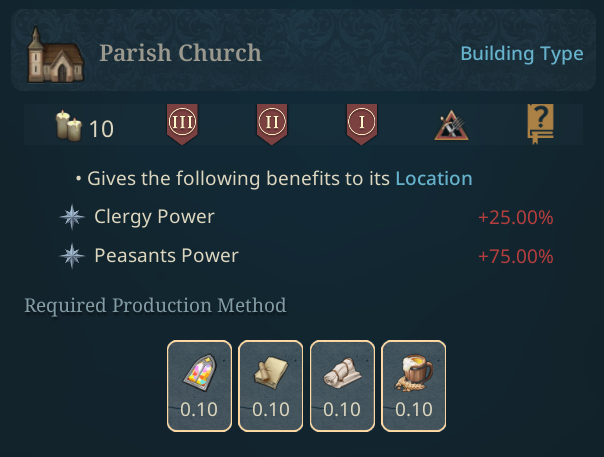
_Estate-built structures can help the economy, but destroying them carries political and satisfaction costs. Official Paradox Tinto screenshot._
Before destroying an estate building, check:
- what it produces;
- whether the market needs it;
- whether the location has workers;
- which estate benefits;
- what satisfaction cost destruction creates;
- whether the building is actually blocking a better plan.
Destroying estate buildings can be correct, but it is not free cleanup.
Early Estate Routine
Use this routine in the opening decades:
- Check crown power and estate power before granting anything.
- Identify which estate is economically important in your start.
- Set taxes conservatively until you understand satisfaction movement.
- Grant only privileges with a clear purpose.
- Avoid pushing key military or economic estates into dangerous dissatisfaction.
- Use extra income to fix control, inputs, and market access.
- Revisit privileges after your economy stabilizes.
- Do not revoke everything at once unless you intentionally plan for the shock.
Common Estate Problems and Fixes
| Symptom | Likely cause | Fix |
|---|---|---|
| Estate satisfaction keeps falling | Taxes too high, privileges revoked, bad events, low equilibrium | Lower pressure, use appeasement tools, reassess privileges |
| Treasury is weak despite good production | Estate tax/capture problem | Check tax rates, control, estate shares |
| Crown power is low | Estates/privileges/reforms dominate authority | Review privileges, reforms, and crown-supporting options |
| Revoking privileges is too expensive | Estate power too high or timing is bad | Build stability first, weaken estate over time |
| Estate buildings annoy you | Estate investment conflicts with plan | Keep useful buildings; destroy only when worth satisfaction cost |
| High taxes cause unrest risk | Satisfaction pressure | Lower rates or improve satisfaction before taxing harder |
Does Crown Power Affect Taxes?
Players often ask this because the interface layers are easy to mix together. The safest way to explain it is:
- control affects how much local value becomes taxable;
- estates receive shares of that value;
- estate tax rates determine how much they pay;
- crown power represents broader state authority and can affect government/economic efficiency depending on current mechanics.
Use the in-game tooltip and current wiki revision for exact values. Do not rely on Reddit debates for formulas.
Next Steps
Estates connect directly to control, debt, and building decisions. If estate taxes are low because satisfaction is fragile, your fix may be food, control, or a better economic base rather than just harsher taxation.
Use the live EU5 Economy Guide as the pillar. Use the EU5 Control Guide for low-control income loss, the EU5 Buildings Guide for estate buildings and input chains, the EU5 Bankruptcy Guide when debt pressure is already visible, and the EU5 Trade and Markets Guide when estate income depends on market access, prices, or trade.
FAQ
What is crown power in EU5?
Crown power is the state's authority compared with the estates. Higher crown power generally means stronger central government and better ability to govern, while low crown power can create efficiency problems.
Does crown power affect taxes?
It is best understood as part of the broader state-efficiency layer, not the same thing as local control or estate tax rate. Check current tooltips before optimizing around exact thresholds.
How do estate taxes work?
Locations create tax base after control is applied. That tax base is divided among estates, and each estate pays the country according to its tax rate and related constraints.
Should I automate estate taxation?
Automation can reduce micro and prevent extreme mistakes. In a crisis, inspect taxes manually so you know whether estate taxation is the actual bottleneck.
Should I grant estate privileges?
Grant privileges when they solve a real problem and the power tradeoff is acceptable. Do not grant every privilege just because the immediate bonus looks good.
How do I raise crown power?
Use reforms, privilege management, crown-supporting choices, and other current-patch tools. Exact options vary by country and patch, so verify in-game before committing to a centralization plan.
What happens if estate satisfaction gets too low?
Low satisfaction can create instability and rebellion risk. It can also make taxation harder. Treat satisfaction as a budget constraint, not just a flavor number.
Sources Checked
- Paradox release date press release: https://www.paradoxinteractive.com/media/press-releases/press-release/paradox-interactive-sets-date-for-europa-universalis-v
- Paradox Wiki Estate: https://eu5.paradoxwikis.com/index.php?mobileaction=toggle_view_mobile&title=Estate
- Paradox Wiki Estate laws: https://eu5.paradoxwikis.com/Estate_laws
- Paradox Wiki Economy: https://eu5.paradoxwikis.com/Economy
- Paradox Wiki Control: https://eu5.paradoxwikis.com/index.php?redirect=no&title=Control
- Tinto Talks Extra – Economy & More: https://forum.paradoxplaza.com/forum/developer-diary/tinto-talks-extra-economy-more-23rd-of-january-2026.1896543/page-7
- Steam EU5 page: https://store.steampowered.com/app/3450310/Europa_Universalis_V/