Ask a veteran which country to pick first in Europa Universalis 5 and watch them flinch at the word Portugal. A decade of EU4 trained everyone to reach for the safe coastal underdog, and EU5 punishes that reflex. Most of the old tutorial favorites are bad first campaigns now, because the game no longer runs on the same engines. Population is a real resource that underpins your army, your taxes, and your recovery. Control decides how much of your own country you actually own. Markets sit between your land and your income. A nation that was simple in EU4 can be a management nightmare here, and a big "scary" country like Castile can be the gentlest teacher on the map.
Your first country is a difficulty multiplier. Pick well and the game teaches you its systems one at a time — economy, estates, control, war, trade, colonization. Pick badly and every system arrives at once, on fire, while a coalition forms on your border. The rest of this page gives you the mental model for judging any start, then the concrete picks ranked by what they teach.
What Makes a Nation Beginner-Friendly
Forget tier lists for a moment. Every recommendation in this article comes from six properties you can check yourself on any country, in any patch. If you understand why these matter, you will never need to memorize a ranking again.
1. Population is the foundation, not a bonus. Ducats pay for actions, but people pay for everything: levy size, manpower, tax base, urbanization, long-term scale. A country that starts with millions of population can lose wars, waste money, and still recover. A country with a small population has to be right about everything. This is why the biggest, most boring countries keep topping beginner lists, and why Castile at roughly five and a half million people feels almost unfair next to a one-million-population Italian state.
2. Control is the multiplier on everything you own. Control spreads outward from your capital and decays with effective distance. Flat terrain spreads it easily, mountains strangle it, rivers act like highways, roads help, and a coastline plus an active navy extends it over sea lanes. Every location you own is taxed, recruited from, and developed at the rate its control allows. A capital sitting on a flat, river-laced plain runs a large realm comfortably. The same country with a mountain-ringed capital stays stuck in a tiny isolated area no matter how much land you paint on the map.
3. Market shape decides whether the economy is legible. Resources do not flow into your country. They flow into markets, and your country draws from the markets it participates in. The cleanest learning setup is one market where you are the only member: every cause and effect is yours to read. The worst is a shared or split market where your income depends on strangers. Castile famously starts split across two markets, which is actually a gift — it is the single cleanest demonstration in the game of how the economy really works — but you should automate trade there rather than wrestle it by hand.
4. Peace buys learning time. A country that starts at war forces you to learn supply, morale, sieges, and war exhaustion before you understand your own budget. Strong countries that start at war get demoted in every serious beginner ranking for exactly this reason. A decade of quiet is worth more than a strong army you do not know how to use yet.
5. Self-sufficiency in basics removes friction. Food, wood, and stone are the unglamorous goods that keep a young economy moving. Food is the resource that buys urbanization — run out and your cities stop growing. Countries that must import basics start every campaign with a tax on their attention. Countries that own gold or silver on top of the basics can double their income just by satisfying domestic demand.
6. Forgiveness is size plus population. The best beginner countries share one boring superpower: they can lose twenty wars and still not fall. Small does not mean simple. A tiny state has fewer provinces to inspect, but also less income, fewer diplomatic options, weaker armies, and zero room for a bad war. Your first campaign should be a country that survives your mistakes, not one that demands perfection before it lets you learn.
Read the Start Before You Commit
Tinto rebalances nations in nearly every update, so the durable skill is not knowing which flag is currently S-tier. It is reading a country's start screen the way a veteran does. Before you unpause any campaign, spend five minutes on these six checks. They answer every question a tier list would answer, and they never go stale.
| What to read | Where in-game | Beginner-friendly looks like |
|---|---|---|
| Population | Country overview, demography panel | Millions of people; you outscale at least one nearby rival. |
| Control geography | Control map mode, capital province tooltip | Capital on flat, river-laced terrain; most core land already reachable. |
| Market shape | Economy panel, markets tab | You own your market, ideally as its only or dominant member. |
| Starting wars | Diplomacy screen, alerts bar | No active war at the bookmark; no scripted war inside a decade. |
| Basic goods | Production tab, market search | Food, wood, and stone at home; gold or silver somewhere in reach. |
| Ruler and estates | Government tab, estates panel | Decent administrative and diplomatic ruler; estates settle above half satisfaction without bribes. |
Two of those checks deserve extra emphasis because beginners systematically misread them. First, the economy: a production building earns gross income, but that income enters the location's potential tax base, gets reduced by whatever control the location is missing, and only then gets split among the estates and taxed at the rate you set. A tailor's guild that earns nine ducats does not put nine ducats in your treasury. You receive your taxed share of the control-adjusted base. Understand that pipeline and you understand the entire economy; ignore it and you will keep wondering where the money went.
Second, the estates. Keep every estate above fifty percent satisfaction and you will barely notice them. Let them slide below twenty-five percent and they pay less tax and send fewer men to your levies. The nobility is the dangerous one — let it drop below forty percent and noble rebellions start, and they are genuinely nasty. The clergy is the special case: as a Catholic country you cannot tax it at all, but its satisfaction is the one happiness number that truly matters, because it scales your scientific research. A country whose estates are cheap to keep content is a country that lets you learn everything else in peace.
Best First Campaign: Castile
Castile is the country experienced players boot up to test a patch, and that tells you everything. It is big, rich, populated, and stable no matter what gets rebalanced around it. At the 1337 bookmark it fields the largest population in Europe, an immensely powerful army, a wealthy wool-driven economy, and almost every basic good it needs at home. It is simply a gigantic country: you could lose twenty wars and still not fall. For a first campaign, that forgiveness is the whole point.
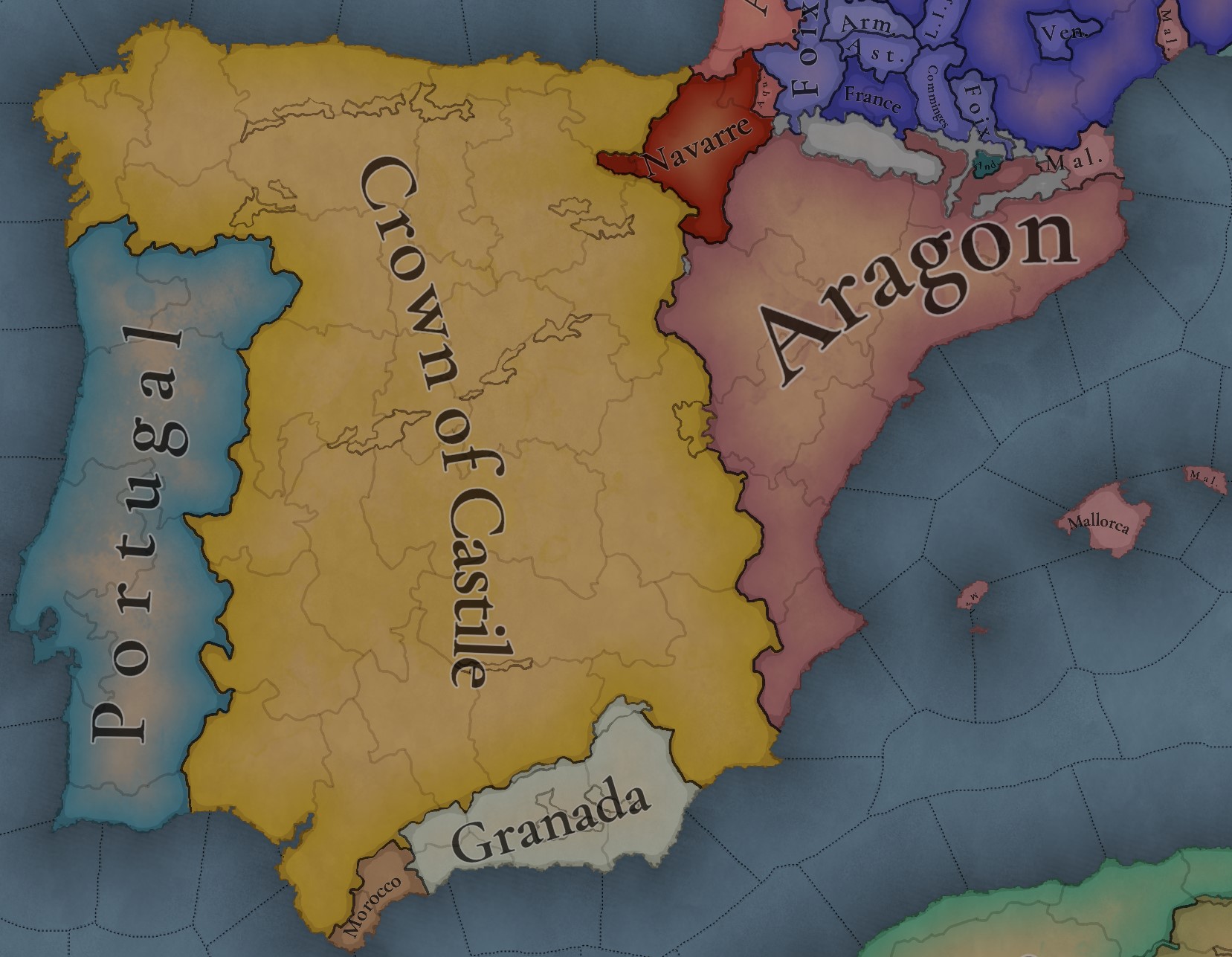
Iberia is not empty space. Castile's safety comes from scale, not isolation — Portugal, Aragon, Navarre, and Granada are all part of your first fifty years.
What makes Castile the best teacher is that its problems are instructive rather than punishing. It starts split across two trade markets, which is the cleanest possible demonstration that resources belong to markets, not to your flag — a resource can literally sit inside your borders and belong to the other market. Set trade to automatic and let that lesson land without making it homework. After you take Granada you inherit a religious and cultural minority that is the perfect safe sandbox for learning tolerance and assimilation, because the stakes are low and the tools are all on display. Its governments trend toward royal authority, so centralization — the value that raises crown power, trade income, and control — happens almost by accident.
A strong opening sequence, once you have read the start screen:
- Automate trade immediately. Two markets is a structural fact, not a minigame you must win by hand.
- Place a governor in Toledo and one in Sevilla. Between them they cover nearly all of Iberia, because the rivers carry control for them.
- Release Galicia as a subject and feed the Basque provinces to a vassalized Navarre. Those two corners are the exceptions your governors cannot reach, and subjects handle them while keeping your budget permanently positive.
- Move the capital to Toledo. The move is gated on books — import them through the Sevilla market or build a scriptorium — and it puts your capital on a city with superb control projection. Control rises gradually after the move; the cabinet action that increases province control speeds it up.
- Take Granada the smart way. Convene your national assembly, pass a preparation-for-war agenda, win a short war, then release Granada as a vassal instead of integrating it directly. Direct integration takes decades per province; vassalize, improve relations, and annex in ten to fifteen years, and in the same time you will gain several provinces instead of one.
- Keep Alfonso XI alive. His marriage to the Portuguese heir carries a real chance of a personal union with Portugal. Dynastic luck is part of the Castile fantasy, and it rewards patient players.
The long arc writes itself: unify Iberia, reach the gold of Mali by diplomacy or conquest, ride your wool monopoly into fabrics and books, and then look past the Pillars of Hercules. Played patiently, a Castile campaign can stand near twenty-five million people by 1500 — roughly two and a half times what a war-focused England run reaches in the same period. The only genuine flaw in the start is the capital's placement, and you fix that yourself. If you want the step-by-step version, the Castile first 50 years guide covers the full opening, and the EU5 economy guide explains the tax-base pipeline in depth.
The Safest Land Sandbox: Hungary
If Castile is the best all-round teacher, Hungary is the quietest one. It sits in the middle of Europe, owns its own market as the dominant member, and is strong enough to try any playstyle without being punished for inexperience. No early navy to manage, no colonial race to lose, no scripted great-power war on your doorstep. Just you, your rivers, and your mines.
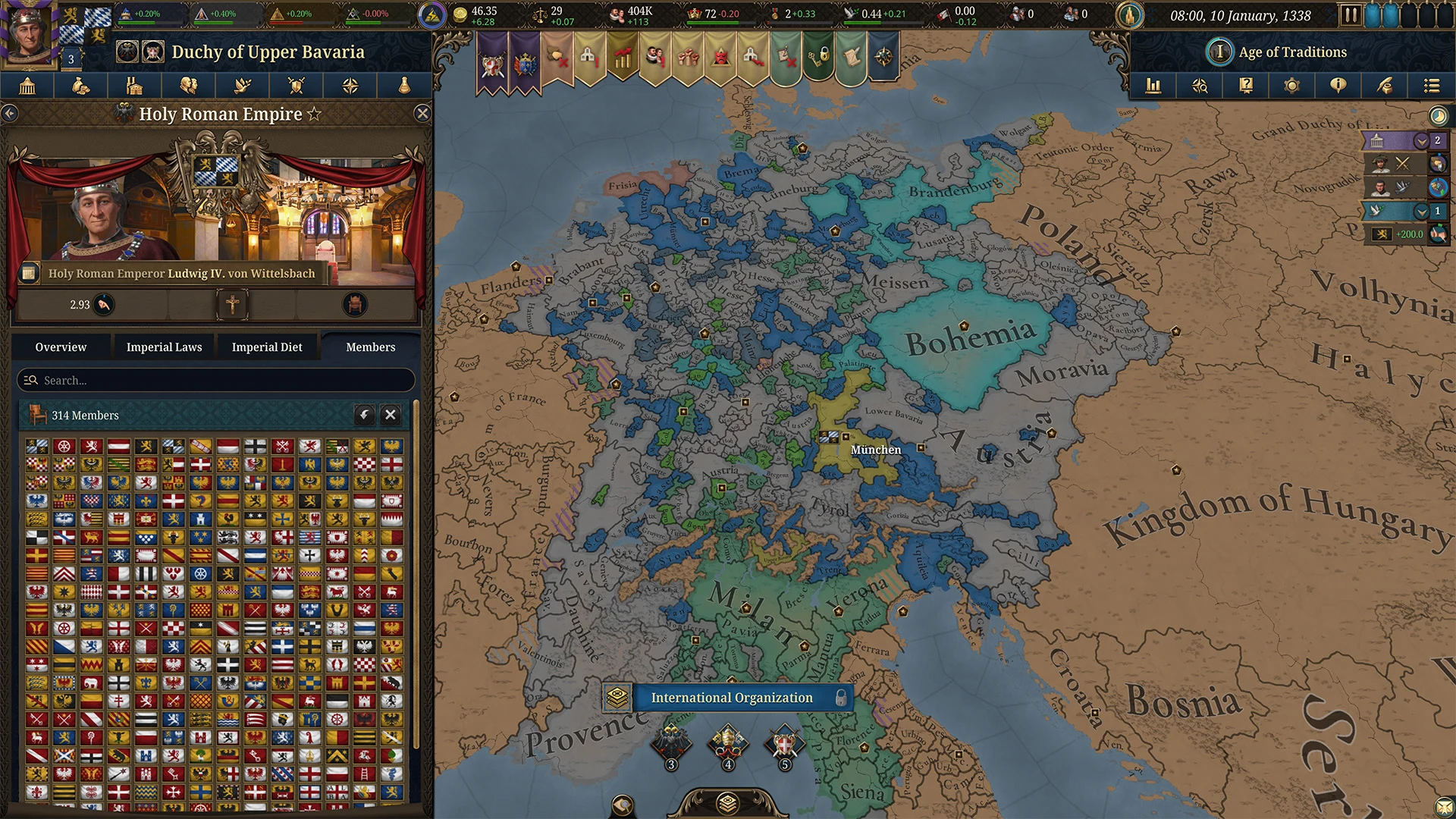
Hungary's first fifty years are a land game: economy, control, mines, and careful Balkan diplomacy. The navy can wait forever if you want it to.
Hungary's economy has one deliberate knot you must untie, and untying it is the lesson. The country starts rich in gold and silver — and with a law banning the export of gold and silver, which caps the very advantage that makes it rich. Your first parliament exists to fix this: request the law change, then build trade capacity and export your precious metals to spin the economy up. That single sequence teaches laws, parliament support, and trade in one move.
Everything else about the start is generous. The river network flowing through Hungary acts as a control highway, which makes the country a natural classroom for the control system — develop down the Danube from Buda and watch value spread. Cavalry bonuses and a solid population mean you can fight any regional neighbor, with two exceptions: a fully grown Ottoman realm, and Bohemia, which deserves respect rather than war. Hungary's expansion pattern is subjugation, not annexation: vassalize Balkan neighbors, unify the region's gold and silver under your market, and only absorb land when it is cheap.
One warning that quietly decides Hungarian campaigns: institutions spread through trade, and Hungary receives little inflowing trade from the places where institutions spawn. Left alone, your tech lags. Import a healthy amount of goods from the Venetia market and institutions arrive on schedule. It is a small line item with an outsized effect, and it is the kind of thing no alert will ever tell you to do.
If you want the same sandbox with Holy Roman Empire content bolted on, play Bohemia instead: the best ideas in Europe, an early personal union with Poland, and a realistic shot at the imperial title. The Hungary first 50 years guide walks through the full opening, the control guide explains why rivers matter so much, and the estates and crown power guide covers the parliament mechanics in full.
Maritime Starts: Portugal, Aragon, Naples
Naval play is its own archetype, and it is more beginner-friendly than land war in one specific way: a strong navy does not just win sea battles, it lets you skip strong armies entirely. While a land power grinds through forts and attrition, a naval power cherry-picks rich strategic targets — islands, trade centers, coastal gold — and only fights neighbors on its own terms. If that sounds like your kind of game, these three are the maritime school.
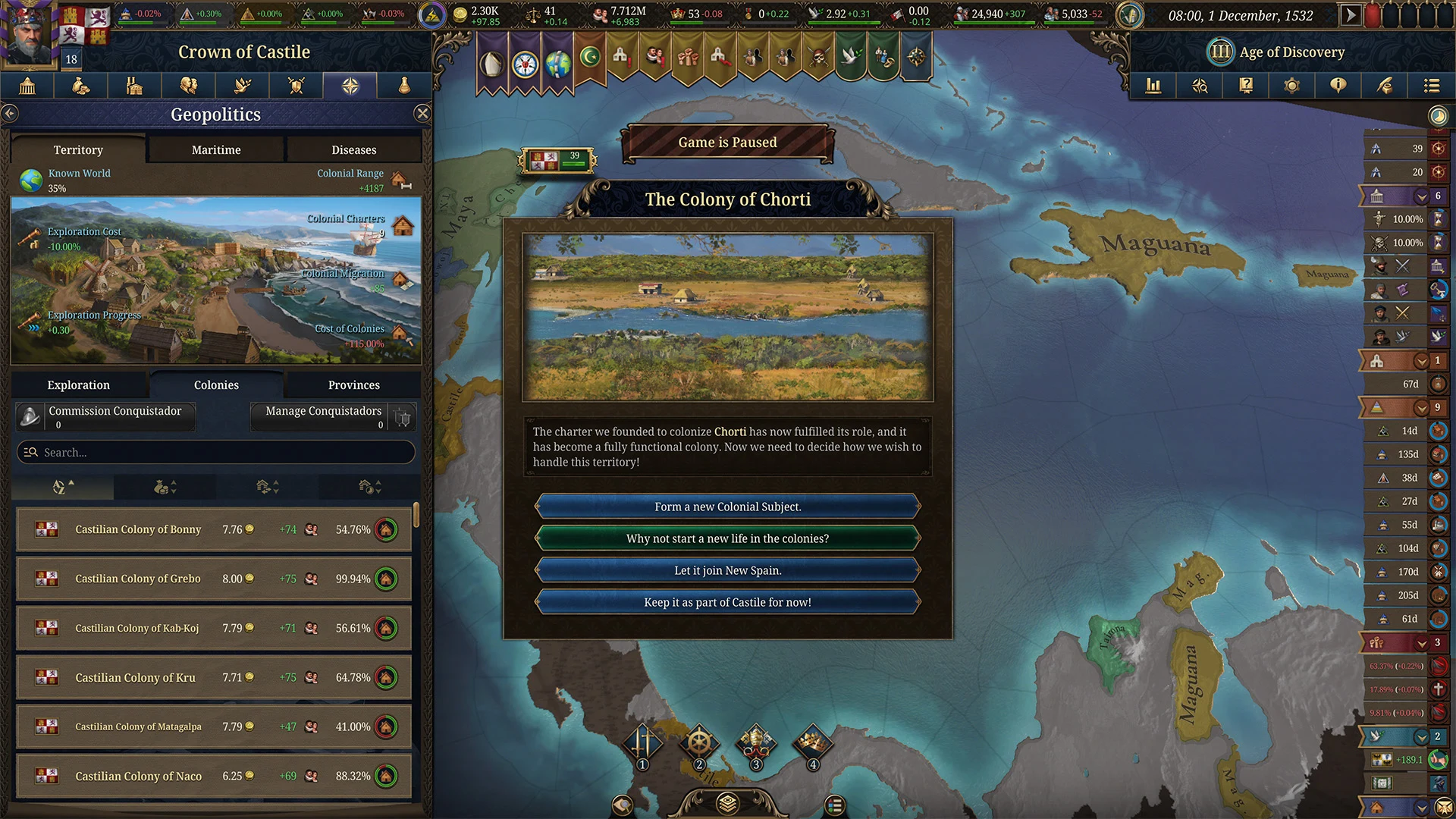
Atlantic ambitions are built on a boring foundation: home security, a positive budget, and a navy you can afford before you can afford colonies.
Portugal is the quiet economic start: iron for tools, wool for textiles, lumber for cheap early buildings, and a natural path toward the Atlantic. But it is not the passive tutorial island EU4 veterans expect. Your good-relations bonus with Castile decays, and Castile is the fact of your existence. Befriend Castile, avoid Castile's rivals, and stay well clear of Aragon — Castile holds an Aragonese core, and Aragon spends its early years being dogpiled by France. Two practical moves fix the Portuguese budget: delete every fort except the capital one, because fortification maintenance wrecks a small starting income, and treat exploration as the luxury purchase it is. Early exploration costs around ten ducats a month, which is enormous on a thin income. Open your budget and do the math: until exploration is a fifth of your net income or less — realistically fifty to a hundred ducats a month — you cannot afford it. Nobody steals your colonies while you build the economy that makes them cheap.
Aragon plays the naval build order in its pure form. Do not fight Castile or France early. Play tall, take Sardinia, Sicily, and the Morea for their resources, then Tunis, Naples, Alexandria, and Constantinople for their market centers. That income stream is what funds the great-power wars later. Aragon teaches patience as a strategy: the map looks tempting in every direction, and the correct move for decades is to get rich first.
Naples is the strongest Italian state and the same loop with harder neighbors: a central seaside capital, a large population, silk production, an easy Byzantine gold mine within reach, and trade-office buildings that plug you into the Mediterranean network. Its two catches are political. The Pope does not tolerate Italian conquest quietly, and excommunication is a real cost of expansion — keep the Papacy friendly or expand carefully. And Naples starts with personal unions that decay almost immediately; holding them requires integration investment and seniority law, roughly a decade of deliberate work. One Italy-wide rule applies to every peninsula start: food buys urbanization, and Italy is food-poor. Expanding into central Italy without stacking food output is how wealthy city-states quietly stagnate.
The Portugal first 50 years guide and the trade and markets guide turn this archetype into a concrete campaign plan.
War-Content Starts: England, France, Ottomans
Some players want the game's scripted wars to be the teacher. These three starts hand you a conflict with built-in stakes and let you learn supply, crown power, and peace deals under pressure. They rank below Castile and Hungary for a first game only because war is a harsher classroom than economy — but if you know yourself, pick accordingly.
England is the safe version of a war start because it is an island. You can press the Hundred Years' War or abandon it; even losing it is recoverable, because you retreat behind the channel and rebuild. The economy is excellent — a wool monopoly that scales into fabrics and books, plus two of the three silver sources in the British Isles — and the war-bow levies are among the strongest in the early game. Your defining early stat is crown power: below roughly a quarter, parliament turns against you and everything gets harder, so favor the crown in early assemblies and put the king in command of armies for the command bonus. Build a navy early, around thirty ships, and set patrol missions across your seas — maritime presence pushes coastal control for a fraction of its normal cost, which is how island empires stay coherent. Two traps to know: event-spawned buildings in Cornwall quietly lower provincial control, so watch that province, and forming Great Britain is historically underwhelming because England already unlocks most of what it grants.
France is maximum flavor: the Hundred Years' War, the Black Death arriving early, and one of the deepest event pools in the game. It starts at war and still has the population and wealth to do virtually everything from turn one — fight England, compete for colonies, intervene in the Empire, push into Italy. Delete most of your forts to recover budget, but keep a few on the outskirts for the English war. France is the reward for a second campaign: the same tools England has, with more fronts and more drama.
The Ottomans are the conquest engine. They do not start with a market of their own; they simply take one. A starting reform cuts your aggressive expansion and speeds province integration — read the exact current values in the government panel rather than trusting any fixed number — and that combination lets you consolidate Anatolia, crush Byzantium, and take Constantinople inside a single focused early game. With nearly two hundred events, the Rise of the Turks is both content and scaffolding: the game keeps telling you where to go next. The warnings are real, though. Expect weak finances for the first century while decentralization keeps trade income low. Manage the many social estates deliberately, because a decentralized realm runs on them. Do not attack the Karasid beylik early — an event hands you its subjugation for free if you wait. Egypt fields the strongest levy army in the world and attacks without warning. And treat the capital-move event as a trap dressed as a reward: if you built tall in Bursa, moving to Adrianople strands that value unless you prepare roads and maritime presence first. The warfare guide and diplomacy guide cover the mechanics these three starts stress-test.
Second-Campaign Starts by Archetype
Once one campaign is behind you, the interesting starts are the ones with a sharp identity and a real weakness. Each of these teaches a specific advanced lesson — and each would have drowned you in your first game for a specific reason.
| Nation | Archetype | The hook | Why it waits for campaign two |
|---|---|---|---|
| Bohemia | HRE unifier | Best ideas in Europe, early personal union with Poland, a real shot at Emperor. | The first fifty to a hundred years are vassal integration, not expansion; embracing Hussitism triggers a Pope-led coalition unless Hungary and Poland are allied first. |
| Muscovy | Deliberate overextension | Cabinet actions that ignore sieges and annexation speed, ruler manipulation through the Veche Republic, buffs from breaking the Tatar yoke. | Rushing the Russian formation grabs huge foreign-culture land unintegrated, eating economy and army penalties plus revolts until you recover. |
| Denmark | Bankruptcy comeback | Claw back from the brink through an Imperial alliance, beat Sweden, then become a Baltic naval power. | You start near bankruptcy with debt, low control, and low legitimacy. It is a comeback story, and comebacks require you to already know every system. |
| A Japanese clan | Timer rush | Sixty-three years of nonstop war to grab as much of Japan as possible before the era flips. | The pre-Sengoku wealth is a trap: when Sengoku triggers you lose your buildings, income, and manpower, and only survive on savings you had the discipline to hoard. |
| Achaea or Athens | Underdog roleplay | Restore the Latin Empire while fighting your overlord, your neighbors, and your own population. | Weaker than nearly everything on this page. The most entertaining way to play — and the least forgiving. |
| Korea | Tall economy | Massive gold, self-sufficient food and materials, a philosophical school aimed at research. | You start as a vassal of the Great Yuan, which collapses on its own within decades — and then you must expand or inherit the wreckage, on a timer. |
| Vijayanagar | The hundred-year race | Cavalry bonuses, reduced distance-from-capital costs, and a rich south to build an empire from. | If you do not expand south within roughly a century, someone else does. The Delhi Sultanate raids you for money, and you must import wood and stone. |
Starts to Avoid on Your First Game
These countries are not bad. They are bad teachers. The distinction matters, because every one of them has a passionate fanbase — and every one of them will make your first campaign harder for a reason that has nothing to do with skill.
- Any country that starts at war. Morocco is the textbook case: two million people, tribal cavalry, gold and goods at home, and an opening war against Tlemcen with a Castile war brewing over a border province. It is a strong country and a miserable first game, because you learn the economy while it is on fire. Sell the disputed province to Granada if you must buy peace — the lesson is worth more than the land.
- Management leviathans. China is the extreme example: a massive population, many cultures, internal power dynamics, and a late-game date with Western colonial empires. It becomes viable once you can juggle trade, population, production, and military at the same time. Not before.
- Declining empires surrounded by enemies. Byzantium begins far larger than its EU4 version and still gets to die — saving it takes diplomatic and defensive skill that a first campaign cannot supply. The Mamluks demand both a powerful navy and a strong land army simultaneously.
- Tiny states that look simple. Milan rules a third of its own territory at start and spends thirty years just integrating the rest; HRE minors live inside coalition politics you have not learned yet. Fewer provinces means fewer mistakes allowed, not fewer things to learn.
- Your EU4 reflex pick. The countries that were safe in EU4 are mostly not safe here, because population, control, and markets changed what "safe" means. If a pick feels obvious from a decade of habit, that is the tell to double-check it against the start screen.
- Comeback starts that hinge on luck. Brandenburg's revenge arc can depend on events going your way, and Serbia front-loads hard — a great first decade, then a long fall-off while low population and poor roads catch up with you.
You can play all of these later, and you will enjoy them more then. Your first campaign should teach you the game, not test whether you can survive before you know what every alert means.
FAQ
What is the best starter nation in EU5?
Castile, for most players. It has Europe's largest starting population, a wealthy self-sufficient economy, an army that forgives mistakes, and content that teaches estates, control, war, and colonization in order. Hungary is the answer if you specifically want a quiet, land-only first game with a transparent one-market economy.
Is Portugal a good first country?
It is a good maritime school, but it is not the safest first pick, and the EU4 habit of reaching for Portugal first is exactly the reflex EU5 punishes. Portugal lives next to Castile, its good-relations bonus decays, and early exploration is a luxury purchase that can bankrupt a thin income. Secure the friendship, build the economy, then look outward.
Should beginners start as a small country?
Usually not. Small countries have fewer provinces to look at but less income, weaker armies, fewer diplomatic options, and no room for a lost war. EU5's population and control systems make a large, boring country far easier to learn from than a one-province survival puzzle.
Do EU4 beginner nations carry over to EU5?
Mostly no. Population is now a real resource, control decides how much of your realm you actually own, and markets sit between your land and your income. Countries that were simple under the old systems can be management nightmares now, while big starts like Castile turned out to be the gentle teachers.
How do I know if a patch changed which nation is best?
Stop chasing the tier list and read the start: population, control geography, market shape, starting wars, basic goods, ruler and estates. Balance numbers move every update, but those six questions have not changed yet, and answering them yourself beats trusting any fixed ranking — including this page.
What should I learn first, economy or war?
Economy. Your levies are raised from population and will carry your early wars with almost no regular army — in fact, disbanding the early standing army to save maintenance is the correct move for most starts. Learn why your tax base moves, why control matters, and why estates must stay content; the wars will be much easier once the money makes sense. The EU5 beginner guide sequences the whole first campaign.
Next Reads
- EU5 Beginner Guide: First 50 Years — the full opening checklist for any nation.
- Castile First 50 Years — the recommended first campaign, step by step.
- Hungary First 50 Years — the quiet land-only alternative.
- Portugal First 50 Years — the maritime and colonial route.
- EU5 Economy Guide — the tax-base pipeline, markets, and minting explained.
- EU5 Control Guide — why rivers, roads, and capitals decide how much of your country you own.
- EU5 Estates and Crown Power Guide — satisfaction thresholds, privileges, and parliament.
- EU5 Trade and Markets Guide — how resources actually reach your treasury.
- EU5 Warfare Guide — levies, supply, sieges, and early-era combat.
- EU5 Diplomacy Guide — alliances, antagonism, coalitions, and vassals.
- EU5 Austria Guide and EU5 Ireland Guide — two sharper country routes once the basics are second nature.