
The best building in EU5 is not the same in every country, every patch, or every market. A building is good when it fits the location, has workers, gets inputs, sells useful output, and produces value your state can actually capture.
That is why fixed build orders age badly. EU5's economy is built around markets, goods, production methods, pops, control, and estates. If one of those layers is wrong, a building that looked profitable can become dead weight.
Use this guide as a decision framework. For the broad economy overview, start with our live EU5 Economy Guide. If your problem is prices, routes, imports, or exports, use the EU5 Trade and Markets Guide. If a rich location still does not pay, check state reach in the EU5 Control Guide.
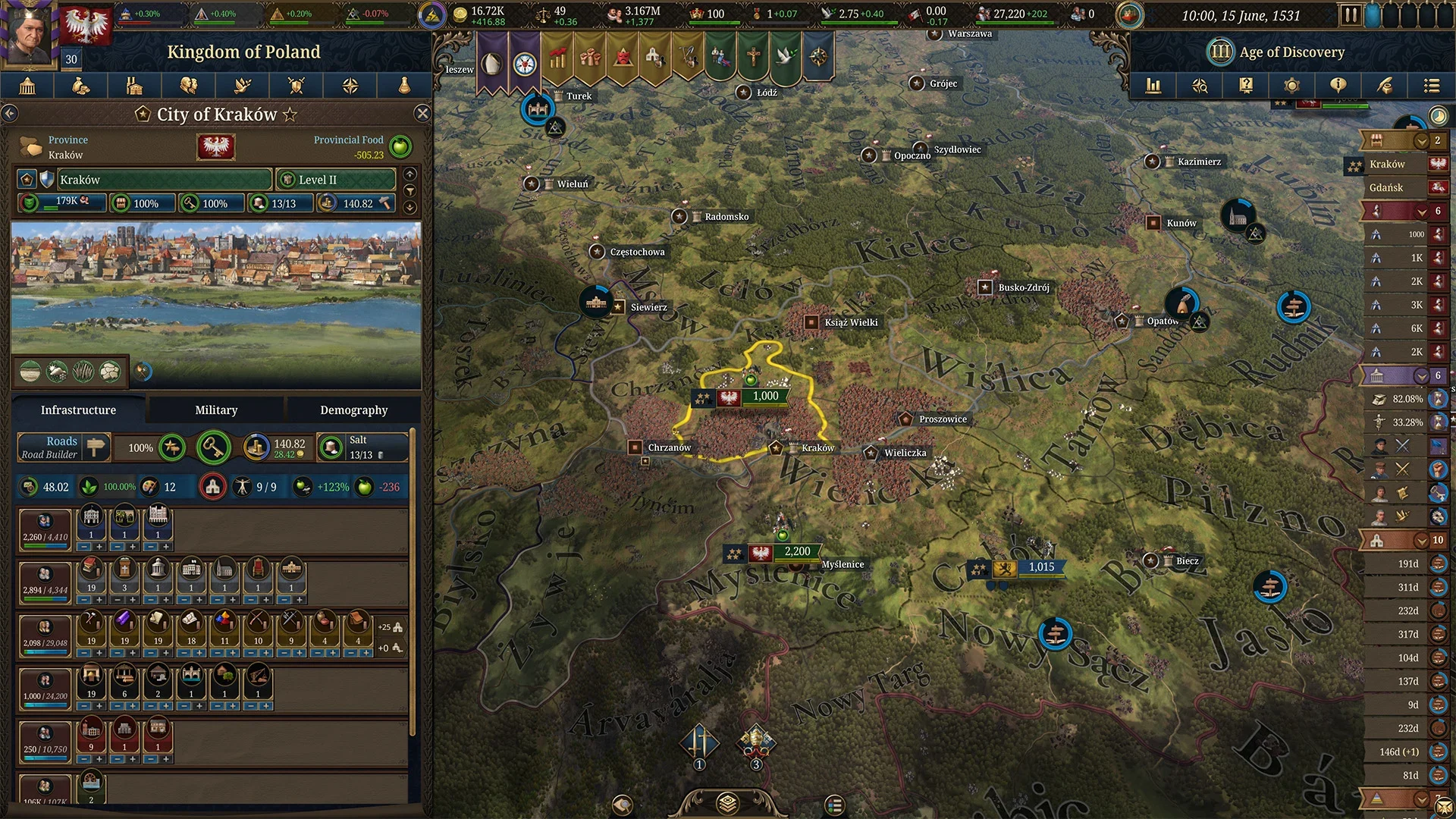
_Buildings are location decisions first: slots, infrastructure, workers, control, and market connection all matter. Official Paradox screenshot._
Quick Answer: What Should You Build in EU5?
Build the thing that fixes your current bottleneck.
| Problem | Usually look for |
|---|---|
| Construction is slow or expensive | Lumber, tools, stone, construction input chains |
| Buildings lack inputs | Local production or imports for the missing good |
| Food is tight | Food RGOs, food-supporting buildings, imports |
| Trade capacity is capped | Trade buildings in the relevant market |
| Rich locations pay little | Control/proximity infrastructure before more output |
| Pops are unemployed | Buildings/RGOs that match local workers and market demand |
| Output price is collapsing | Stop overbuilding that output; find exports or diversify |
The point is not "always build X first." The point is to identify what prevents your economy from growing.
The Building Value Checklist
Before spending on a building, check six things.
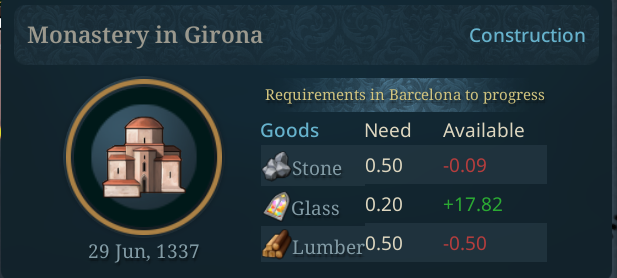
_Construction stalls or slows when the local market cannot supply required goods. Official Paradox Tinto screenshot._
1. Does the location have control?
Control affects how much location value becomes useful tax base. A building in a high-control core can pay back much faster than the same building in faraway low-control land.
If the building is meant to solve a strategic shortage, low control may be acceptable. If it is meant to make the treasury richer, low control is a serious warning.
2. Does the location have market access?
Market access affects whether the location can participate in the market properly. Low access can reduce production value and make inputs unreliable.
Do not evaluate a building only by what it produces. Ask whether it can buy inputs and sell output.
3. Are inputs available?
Most buildings have production methods. A production method requires goods. If the market cannot supply those goods, the building will not function at full strength.
Tinto Talks #9 explains the core idea clearly: production methods require goods, and effectiveness scales with the lowest available required input. The current wiki also notes that buildings lose output when their production method cannot get enough market resources. If a required input is short, the whole method suffers.
4. Are workers available?
Buildings need employed pops. If a location lacks suitable workers, a profitable building may not fill quickly. RGOs also need laborers or slaves, and expanding raw output without workers is not instant money.
5. Is the output in demand?
A building that produces a locally flooded good may become less profitable. A building that produces a needed input can support an entire chain even if its direct profit is not spectacular.
6. Will the crown capture the value?
EU5 does not route all value straight into the state treasury. Control, estate shares, estate tax, and crown power/government authority all affect the final outcome. If estates capture most of the benefit and pay little tax, the building can help the country on paper while barely helping your budget.
RGOs vs Urban Buildings
RGOs produce raw goods through mines, farms, forestry, hunting grounds, and gathering operations. They are often the first place to look when your market lacks basic resources, food, or valuable raw materials.
Urban buildings are more likely to process inputs into finished goods, support trade, improve state capacity, or provide specialized effects.
| Choose RGOs when | Choose urban/production buildings when |
|---|---|
| You need raw materials | You have inputs and workers for processing |
| Food or construction inputs are missing | Your market has demand for finished goods |
| A location has a valuable raw good | A city/town can support workers and market access |
| You need a simple early investment | You want a production chain or strategic effect |
Do not expand RGOs just because a good is valuable globally. Check workers, market access, control, and whether more supply will crash the local price.
Production Methods Explained
Production methods decide what a building consumes and produces. They can make a building stronger, more efficient, or more specialized, but they also create input requirements.
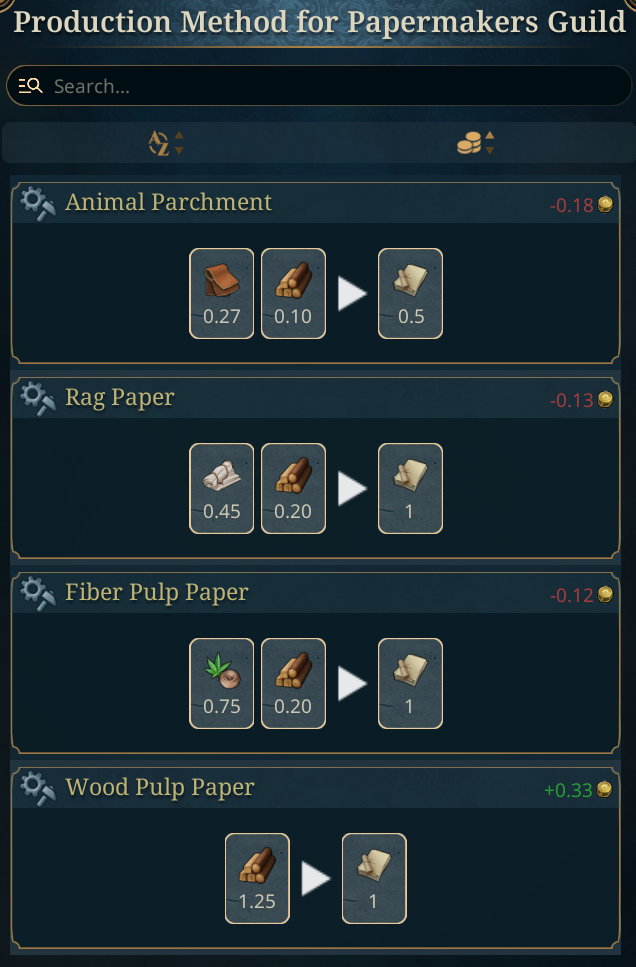
_Production methods trade input requirements against output and profit. Official Paradox Tinto screenshot._
Use this rule:
- If the market reliably supplies the inputs, advanced production methods can be strong.
- If the market cannot supply the inputs, a simpler method may outperform the "better" method.
Automation can be useful. Tinto Talks suggested many players can leave production method selection automated, while advanced players may want manual control. In a live guide, phrase this conservatively: automation is fine for most routine buildings, but manually check strategic buildings and bottleneck goods.
Why Buildings Do Not Hire Workers
A building may fail to hire or may fire workers when its potential profit is negative or when the location lacks appropriate pops. As checked on May 5, 2026, the wiki explains potential profit as a comparison of output value against input costs, modified by market price, market access, production efficiency, and employment. It also says a building with positive potential profit hires each month if population is available, while a building with negative potential profit can fire employees unless subsidized.
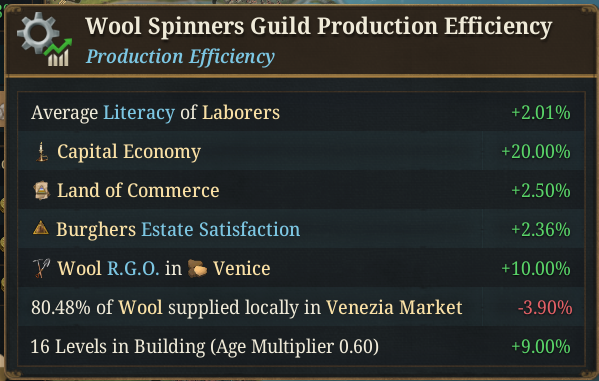
_January 2026 economy changes made local input supply more important for production efficiency. Official Paradox Tinto screenshot._
Common causes:
| Symptom | Likely cause | Fix |
|---|---|---|
| Building does not hire | Negative potential profit | Check input/output prices and market access |
| Building lacks inputs | Market shortage or trade/access issue | Import input or build local production |
| Output price is too low | Oversupply | Stop expanding that output, export surplus, diversify |
| Workers are missing | Wrong pop base or competition | Build where workers exist or wait for promotion/migration |
| Strategic building is unprofitable | Useful output but bad market math | Subsidize only if the strategic value is worth it |
Subsidies can keep a building running, but they are not free. Use them for strategic goods, not to hide a bad investment forever.
Estate Buildings: Keep, Ignore, or Destroy?
Estates can construct buildings. The wiki notes that estate construction cannot be canceled, and destroying an estate-built building reduces that estate's satisfaction.
Treat estate buildings as part of the economy, not as automatically bad.
| Estate building situation | Recommendation |
|---|---|
| Produces useful input or food | Usually keep |
| Supports a profitable local chain | Keep or tolerate |
| Floods market with low-value output | Consider later cleanup |
| Blocks a location plan | Weigh satisfaction cost before destroying |
| Strengthens an estate you are trying to weaken | Review with estate/crown plan |
Destroying an estate building can solve a local problem but create a political problem. Do it deliberately.
Early Building Priorities by Problem
If construction inputs are short
Look at lumber, tools, stone, and related chains. Building without construction inputs can become slower or more expensive, and every later investment suffers.
If food is short
Food shortages can damage growth, satisfaction, and stability. Build or import food before trying to build a luxury economy.
If trade capacity is the bottleneck
Build trade infrastructure in the market where useful routes actually exist. More capacity is valuable when it unlocks profitable or strategic routes.
If control is the bottleneck
Infrastructure that improves control or proximity can outperform a shiny production building. More output does not help much if the state cannot capture value.
If your market lacks high-value finished goods
Build production only after checking inputs. A textile, tools, paper, books, or military-goods chain is strong only if the market can support it.
Common Building Mistakes
- Building where control is too low for treasury income.
- Building where market access is too weak.
- Switching production methods without securing inputs.
- Expanding the same output until local prices fall.
- Ignoring workers and employment.
- Destroying estate buildings without considering satisfaction.
- Subsidizing every unprofitable building instead of fixing the underlying market.
- Treating competitor build orders as universal despite patch changes.
Next Steps
Buildings connect to every other economy system. If a building is underperforming, the cause may be trade, control, or estates.
Return to the live EU5 Economy Guide for the full economy loop. Use the EU5 Trade and Markets Guide when the bottleneck is prices, access, imports, or exports. Use the EU5 Control Guide when the location is valuable but the state is not capturing the value.
FAQ
What should I build first in EU5?
Build the thing that fixes your biggest bottleneck. In many starts that means construction inputs, food, control/access infrastructure, or trade capacity, but the right answer depends on your market and location.
Why is my building not profitable?
Check input prices, output prices, market access, production efficiency, employment, and control. A building can be theoretically useful but locally unprofitable.
Why is my building not hiring workers?
It may have negative potential profit, missing inputs, weak market access, or not enough suitable workers. Check the building tooltip before adding subsidies.
Should I automate production methods?
Automation is fine for many routine cases. Manually check strategic buildings, expensive chains, military inputs, and any building that suddenly becomes unprofitable.
Should I destroy estate buildings?
Only when the building actively conflicts with your plan. Destroying estate buildings can reduce estate satisfaction, so the political cost may outweigh the economic cleanup.
Are RGOs better than urban buildings?
Neither is always better. RGOs are good for raw goods, food, and basic inputs. Urban buildings are better for processing, trade, state functions, and specialized production chains.
Sources Checked
- Paradox announcement press release: https://www.paradoxinteractive.com/media/press-releases/press-release/europa-universalis-v-announced-be-ambitious
- Tinto Talks #9: https://forum.paradoxplaza.com/forum/developer-diary/tinto-talks-9-24th-of-april-2024.1670510/?prdxDevPosts=1
- Tinto Talks Extra – Economy & More: https://forum.paradoxplaza.com/forum/developer-diary/tinto-talks-extra-economy-more-23rd-of-january-2026.1896543/page-7
- Paradox Wiki Building: https://eu5.paradoxwikis.com/Buildings
- Paradox Wiki RGO: https://eu5.paradoxwikis.com/RGO
- Paradox Wiki Market: https://eu5.paradoxwikis.com/Market
- Paradox Wiki Control: https://eu5.paradoxwikis.com/index.php?redirect=no&title=Control
Debt Check
Buildings are only good investments when the campaign can survive the payback period. If loans, inflation, or bankruptcy pressure are already compounding, read the EU5 Bankruptcy Guide before starting another construction wave.
Estate Check
Estate buildings and estate tax capture can change whether a building helps the state budget. Use the EU5 Estates and Crown Power Guide before destroying estate buildings or pushing taxes harder.